Headline evidence · Public procurement · United Kingdom · spending 2025–26 · commitments June–September 2026

None of eleven public-buying promises has reached a contract. Government spent £461bn on buying in 2025–26.

None of the eleven public-buying promises we track has yet reached a contract. Government spent £461bn on buying goods and services in 2025–26, including purchases from other public bodies.

Proposed outcome: Make public contracts deliver better results and value over their full lifetime. What could change →

Geography
United Kingdom
Evidence period
2025–26, outturn
Evidence status
Site calculation from published data
Editorial review
Reviewed 11 October 2026

The short version

Three key measures

  • How much does the public sector spend buying things?

    £461.3bn

    Public-sector purchases of goods, services and buildings. Some are purchases from other public bodies, not private firms.

    United Kingdom · 2025–26, outturn · Site calculation from published data

    Definition, limits and source: How much does the public sector spend buying things?

    Whole public sector gross procurement, current plus capital (central government alone: £295.9bn). Includes purchases from other public bodies, so it is not all spending with private firms.

    Site calculation from published data · HM Treasury, Public Expenditure Statistical Analyses (PESA) 2026 — Tables 5.3 and 6.5

    Who buys what? →
  • How far have this year’s procurement promises got?

    0 of 11at contract stage

    The commitments checked have not yet become contracts. Some new rules start in 2027.

    United Kingdom · Checked 11 Oct 2026

    Definition, limits and source: How far have this year’s procurement promises got?

    Four are published rules (applying from 2027), five are announcements only, and two are outcomes with no measure yet.

    Administrative data · Cabinet Office, Measures to rewire the state (press release)

    From award to delivery →
  • How many major projects look undeliverable as planned?

    20%of rated projects rated Red

    Major projects judged at serious risk of not delivering as planned. This is a warning, not a count of failed projects.

    United Kingdom (government major projects portfolio) · 31 March 2026

    Definition, limits and source: How many major projects look undeliverable as planned?

    34 of 172 rated government major projects at 31 March 2026, where successful delivery appears unachievable without major changes. 16 of the 189 projects had ratings withheld and 1 was not yet rated. In defence, 41% of rated projects.

    Published statistics · NISTA, Major Projects Annual Report 2025-26

    Changes, overruns and recoveries →
Who feels this most?

When a contract fails, the people who were meant to receive the service carry the cost first — and taxpayers pay twice if the work has to be bought again. The government’s own delivery-confidence ratings show where that risk is highest.

The evidence

How far has each procurement commitment actually travelled?

None of eleven commitments has reached a contract; four are published rules

United Kingdom (central government rules; English and UK bodies as stated in each rule) · Commitments announced June to September 2026; checked 11 October 2026
  • Reached
  • Published, not yet in force
  • Not yet
  • No measure exists
Commitment and latest verified stageAnnouncedRule in forceTender or awardDeliveryMeasured outcome
Central government bids scored at least 10% (from £1m) or 20% (from £5m) on jobs and skillsRule published, not yet in forceNext: Detailed guidance, promised for “autumn 2026”. Then the first tender notices from 1 January 2027.Cabinet Office (checked 11 Oct 2026)Reached: Yes (Aug 2026)Published, not yet in force: Published; applies later (see next)Not yet: —Not yet: —Not yet: —
Jobs and skills pledges on £5m+ contracts tracked by KPI and reported publiclyPendingNext: First contract performance notices covering social value KPIs. No first-publication date is specified: the requirement to report at least annually does not prohibit earlier reporting.Cabinet Office (checked 11 Oct 2026)Reached: Yes (Aug 2026)Not yet: —Not yet: —Not yet: —Not yet: Pending: depends on contracts not yet let
Utilities to use their own procurement to support manufacturing jobs and skillsPolicy announcedNext: Guidance to utilities or a bill, promised only “when parliamentary time allows”. No date given.Cabinet Office (checked 11 Oct 2026)Reached: Yes (Sept 2026)Not yet: —Not yet: —Not yet: —Not yet: —
Ofgem asked to factor UK supply chains, jobs and skills into electricity network procurementRule published, not yet in forceNext: Takes effect 17 November 2026 after a 40-day consideration period. Network companies to respond on a voluntary minimum 10% social value weighting in an Electricity Networks Sector Growth Plan (no date given).Department for Energy Security and Net Zero (checked 11 Oct 2026)Reached: Yes (Sept 2026)Published, not yet in force: Published; applies later (see next)Not yet: —Not yet: —Not yet: —
UK manufacturing jobs and apprenticeships created through utility procurementUnknown / not reportedNext: A published metric or reporting requirement. No date given.Cabinet Office (checked 11 Oct 2026)Reached: Yes (Sept 2026)Not yet: —Not yet: —Not yet: —No measure exists: No measure or baseline published
National Shipbuilding Office oversight of all future government civil ship procurementPolicy announcedNext: Shipbuilding and Maritime Technology Action Plan, “planned for later this year” (2026).Cabinet Office (checked 11 Oct 2026)Reached: Yes (Sept 2026)Not yet: —Not yet: —Not yet: —Not yet: —
Replacement Cefas research vessel built in a UK shipyardPolicy announcedNext: Engagement with UK shipbuilders “in the coming months”, then a tender and award. Vessel expected operational 2031 or 2032.Defra and Cefas (checked 11 Oct 2026)Reached: Yes (Sept 2026)Not yet: —Not yet: —Not yet: —Not yet: —
Insourcing Unit in the Office for the Prime Minister and CabinetPolicy announcedNext: Confirmation that the unit is established. No date given.Cabinet Office (checked 11 Oct 2026)Reached: Yes (Sept 2026)Not yet: —Not yet: —Not yet: —Not yet: —
Public Interest Test before contracting out central government services over £1mRule published, not yet in forceNext: 1 April 2027 start. First quarterly return (April to June 2027) due by 30 July 2027. Central publication of results: no date given.Cabinet Office (checked 11 Oct 2026)Reached: Yes (Jun 2026)Published, not yet in force: Published; applies later (see next)Not yet: —Not yet: —Not yet: —
Five-year Insourcing Strategies from bodies with £100m+ annual contract spendRule published, not yet in forceNext: Publication “within 30 days of 1 April 2027”, on each body’s GOV.UK pages or website.Cabinet Office (checked 11 Oct 2026)Reached: Yes (Jun 2026)Published, not yet in force: Published; applies later (see next)Not yet: —Not yet: —Not yet: —
Cabinet Office building management (including cleaning and security) brought back in-housePolicy announcedNext: A Public Interest Test result for these services, then a transition from 2028.Cabinet Office (checked 11 Oct 2026)Reached: Yes (Sept 2026)Not yet: —Not yet: —Not yet: —Not yet: —

New rules and promises have not yet become contracts or delivered results. Some rules do not start until 2027, so the absence of results now is not itself failure.

United Kingdom (central government rules; English and UK bodies as stated in each rule) · Commitments announced June to September 2026; checked 11 October 2026 · Tracker of official documents; moves only when new evidence is published

Show the workings — None of eleven commitments has reached a contract; four are published rules

Each sourced commitment on public buying, insourcing and UK jobs, and the furthest stage evidenced: announced → rule in force → tender or award → delivery → measured outcome. Equal-width stages; no percent-complete figures.

The announcements are real, and several are now written rules with start dates in 2027. But no commitment has yet reached a contract, delivery or a measured outcome — the stages at which public benefit would show. That is a statement about timing, not failure: the rules do not apply until 2027, and the first reports on social-value pledges are unlikely before 2028.

Geography:
United Kingdom (central government rules; English and UK bodies as stated in each rule)
Measure:
Stage reached (categorical)
Period:
Commitments announced June to September 2026; checked 11 October 2026
Status:
Tracker of official documents; moves only when new evidence is published
Calculation:
Each row is placed at the furthest stage for which a primary source exists. A rule that is published but not yet in force is shown as partly reached.
Not included / breaks:
A contract award notice names the supplier’s registered address, not where the work is done. No row counts jobs, savings or outcomes, because none has been published.

Source: Cabinet Office, Measures to rewire the state (press release) (released 2026-09-27).

View the data as a table
CommitmentLatest stageAnnouncedRule in forceTender or awardDeliveryMeasured outcomeNext
Central government bids scored at least 10% (from £1m) or 20% (from £5m) on jobs and skillsRule published, not yet in forceYes (Aug 2026)Published; applies later (see next)———Detailed guidance, promised for “autumn 2026”. Then the first tender notices from 1 January 2027.
Jobs and skills pledges on £5m+ contracts tracked by KPI and reported publiclyPendingYes (Aug 2026)———Pending: depends on contracts not yet letFirst contract performance notices covering social value KPIs. No first-publication date is specified: the requirement to report at least annually does not prohibit earlier reporting.
Utilities to use their own procurement to support manufacturing jobs and skillsPolicy announcedYes (Sept 2026)————Guidance to utilities or a bill, promised only “when parliamentary time allows”. No date given.
Ofgem asked to factor UK supply chains, jobs and skills into electricity network procurementRule published, not yet in forceYes (Sept 2026)Published; applies later (see next)———Takes effect 17 November 2026 after a 40-day consideration period. Network companies to respond on a voluntary minimum 10% social value weighting in an Electricity Networks Sector Growth Plan (no date given).
UK manufacturing jobs and apprenticeships created through utility procurementUnknown / not reportedYes (Sept 2026)———No measure or baseline publishedA published metric or reporting requirement. No date given.
National Shipbuilding Office oversight of all future government civil ship procurementPolicy announcedYes (Sept 2026)————Shipbuilding and Maritime Technology Action Plan, “planned for later this year” (2026).
Replacement Cefas research vessel built in a UK shipyardPolicy announcedYes (Sept 2026)————Engagement with UK shipbuilders “in the coming months”, then a tender and award. Vessel expected operational 2031 or 2032.
Insourcing Unit in the Office for the Prime Minister and CabinetPolicy announcedYes (Sept 2026)————Confirmation that the unit is established. No date given.
Public Interest Test before contracting out central government services over £1mRule published, not yet in forceYes (Jun 2026)Published; applies later (see next)———1 April 2027 start. First quarterly return (April to June 2027) due by 30 July 2027. Central publication of results: no date given.
Five-year Insourcing Strategies from bodies with £100m+ annual contract spendRule published, not yet in forceYes (Jun 2026)Published; applies later (see next)———Publication “within 30 days of 1 April 2027”, on each body’s GOV.UK pages or website.
Cabinet Office building management (including cleaning and security) brought back in-housePolicy announcedYes (Sept 2026)————A Public Interest Test result for these services, then a transition from 2028.

Scroll the table sideways to see every column.

Purchasing over time, and public expectations of government

Annual data: Gross public-sector procurement

Financial-year ENDS: 2026 means 2025–26. PESA 2026 Table 5.3 supplies five outturn years, 2021–22 to 2025–26. The fixed 1996–2026 window leaves earlier years blank rather than joining older vintages with potentially revised definitions. These cash amounts are not adjusted for inflation; a rise does not show improved services or purchasing efficiency. A dash means no comparable observation is supplied; it is not zero. UK public sector, including purchases between public bodies. This is not the value of contracts newly awarded or spending only with private suppliers.

1996–2026; £ billion, nominal. No change is calculated across definition or assessment breaks.

Gross public-sector procurement; £ billion, nominal
YearCurrent procurementCapital procurement
1996–2021No comparable observations supplied
2022279.787.5
2023290.398
2024311.5102.9
2025329.5108.3
2026344.3117

HM Treasury PESA 2026, original Table 5.3

Public expectations were uncertain in the 2023 trust survey

ONS Trust in Government Survey, UK, 2023; released March 2024. These hypothetical questions describe public expectations of integrity and evidence use. They do not measure procurement performance, establish wrongdoing, or evaluate the rules announced in 2026.

Share rating the scenario likely (6–10 on a 0–10 scale), %
  • Public employee would refuse a payment to speed up a service38%
  • Government would use the best available evidence37%
  • Public employee would refuse a payment to speed up a service: 38%, 95% confidence interval 36–41%; question base 1,917.
  • Government would use the best available evidence: 37%, 95% confidence interval 34–39%; question base 1,915.
Exact questions, sample and limitations

If a public employee was offered money by a citizen or a firm for speeding up access to a public service, how likely do you think it is that they would refuse it?

If the UK government takes a decision, how likely do you think it is that it will draw on the best available evidence, research and statistical data?

Fieldwork: 27 September–23 October 2023. ONS invited 4,135 UK adults aged 18 or over and received 1,919 responses (46%). Great Britain respondents had previously completed the Labour Force Survey; Northern Ireland used a NISRA address frame. One person per household could respond, with no proxies. Collection was online, with 1.7% by telephone. Weights calibrate age, sex, region and education.

Question bases differ because missing answers are excluded; “don’t know” remains in these percentage denominators. The two questions are separate measures, not parts of a total. Published confidence intervals describe sampling uncertainty, not all non-response or coverage bias. Previous government-survey participants may have different trust from other people. ONS labels the series official statistics in development.

The linked ONS dataset still lists 2023 as its latest wave at this review. No current-2026 opinion or thirty-year trust trend is inferred, and the one-point difference between these questions is not interpreted as meaningful.

Original tables 3.1 and 3.2 and information sheet · ONS survey methods

Chapter 1

Who buys what?

Most public spending is not procurement: pay, benefits, grants and debt interest are separate. Procurement is what public bodies spend buying goods, works and services. Three figures are commonly quoted for it. They measure different things and cannot be added, subtracted or compared as shares of one another.

£90bn a year

Central government contracts market, as described by government

Period:
“Per year”. No year is given.
Geography:
Not stated
Prices:
Not stated
Definition:
The release calls this “the £90 billion that is spent each year through government contracts”. It does not say which bodies, contract types or year it covers, or where the figure comes from. It is not a PESA measure.
Type:
Government statement (not an official statistic)

Source: Government orders that public spending must back British jobs and skills in every postcode (press release)

£295.9bn

Central government’s own gross procurement, current plus capital

Period:
2025-26, outturn
Geography:
UK
Prices:
Cash (nominal) terms
Definition:
Central government’s own spending on buying goods, works and services (“gross procurement”, current plus capital; PESA Table 6.5). It is a different measure from the £90bn “contracts market” above, and the two should not be compared.
Type:
UK Facts calculation from official statistics
Calculation:
Gross current procurement £214,716m + Gross capital procurement £81,198m. UK Facts sum of two published PESA lines. HM Treasury does not publish this total as a single figure.

Source: Public Expenditure Statistical Analyses (PESA) 2026 — Tables 5.3 and 6.5

£461.3bn

Whole public sector gross procurement, current plus capital

Period:
2025-26, outturn
Geography:
UK
Prices:
Cash (nominal) terms
Definition:
The whole public sector: central government, local government and public corporations (PESA Table 5.3). The National Audit Office notes that the Treasury’s procurement measure includes goods and services bought by one public body from another, so it is not all spending with private firms.
Type:
UK Facts calculation from official statistics
Calculation:
Gross current procurement £344,254m + Gross capital procurement £117,018m. UK Facts sum of two published PESA lines. The NAO’s £393bn estimate for 2022-23 came from the same Treasury statistics series.

Source: Public Expenditure Statistical Analyses (PESA) 2026 — Tables 5.3 and 6.5

A figure this page does not use. The August 2026 release also says public sector procurement “from the private sector” reached “£394.8 billion in 2024/25”, without naming a source. That is not the PESA measure: PESA 2026 puts whole public sector gross procurement at £437.8bn for 2024-25. The two use different definitions, so this page does not compare them or work out a “private sector share” from them.

Chapter 2

From award to delivery

Public money passes through five steps before any benefit can be measured. Select a step to see what the 2026 announcements change at that point and where the evidence will appear. The commitments themselves sit in the ledger above; the binding rule underneath them is the new scoring of bids on jobs and skills.

Step 1 of 5 · Public money

Most public spending is not procurement. Pay, benefits, grants and debt interest are separate. Procurement is what public bodies spend buying goods, works and services.

What the announcements touch
None of the measures changes how much is spent. They change the conditions attached to spending that was going to happen anyway.
What can be checked
HM Treasury publishes procurement totals each July in PESA. The latest year is 2025-26. See “The money, and what each number covers” below.

The rule underneath: scoring bids on jobs and skills (PPN 026)

In August 2026 the government set new rules for how central government scores bids on jobs and skills (“social value”).

  • Applies to central government departments, executive agencies and non-departmental public bodies. Other public bodies “may wish to adopt” it.
  • Covers procurements of £1m or more (total contract value, including VAT) under the Procurement Act 2023.
  • Minimum weighting: 10% of the total score for contracts from £1m to under £5m, and 20% from £5m.
  • Applies to procurements started on or after 1 January 2027. A procurement “commenced” when its tender notice is published.
  • Two outcomes, six criteria: good jobs (create or keep high-quality jobs, fair working conditions, fair pay) and skills (training and retraining, in-work progression, talent pipeline).
  • Contracts of £5m or more (including VAT) should carry at least one social value KPI. The Procurement Act 2023 requires contract KPIs to be published and reported on at least once every 12 months.
  • Does not apply to private utilities’ contracts or to contracts mainly for delivery overseas.

Detailed guidance “will be published in autumn 2026”. It had not appeared when this page was checked. PPN 026 says only that it replaces the “previous edition” of the model. It does not name the earlier note, so this page does not either.

Utilities and UK jobs Policy announced

The release says utility companies, “such as electricity, gas and water infrastructure providers”, will be expected to use their own buying to support “jobs and skills in manufacturing”. It adds: “If companies do not follow the government’s lead, legislation will be brought in when parliamentary time allows to ensure they act.”

Three different things that could all be described as “utilities backing UK jobs”

  1. An expectation: what exists now for utilities as a whole. It has no legal force, target or reporting duty, and it does not yet apply to any particular utility contract.
  2. A binding requirement: what legislation could create. No bill has been published or timetabled. Note that PPN 026, the new social value rules for public bodies, explicitly “does not apply to private utilities contracts”, so it does not fill this gap.
  3. An observed job or apprenticeship: what would show it worked. No measure, baseline or reporting route has been proposed, so there is currently nothing to count.

Electricity networks: one step further, through the regulator

On 14 September 2026 the Department for Energy Security and Net Zero published draft guidance to GEMA, Ofgem’s governing body, “in support of growth in electricity networks through increased domestic manufacturing and supply chain capability”. It takes effect on 17 November 2026. It asks the regulator to “consider where it can incorporate workforce and skills standards” into its approach to procurement, and to consider asking companies to report “domestic versus overseas supply chain spend”. It notes that network companies are not covered by PPN 026. Instead the government “welcomes ongoing discussion” with them on a voluntary minimum 10% social value weighting. This is guidance to a regulator, not a requirement on companies, and nothing equivalent has been published for gas or water.

UK Facts note: network investment by regulated utilities is largely recovered through customers’ bills under price controls set by the regulators. So any extra cost from buying British would be more likely to show up on bills than in public spending. The release does not estimate a cost; the Ofgem guidance says procurement should still support “value for money for billpayers”.

Source: Cabinet Office, Measures to rewire the state (press release), published 27 Sept 2026.

Source: Department for Energy Security and Net Zero, Electricity networks growth: draft social and environmental guidance to GEMA, published 14 Sept 2026.

Civil shipbuilding Policy announced

There are two separate measures here, and they have travelled different distances.

1. Oversight of future civil ship procurement: proposed

The National Shipbuilding Office “will be given oversight of all future civil ship procurement”. The aim is a “clearer and more predictable pipeline of demand” and “a simpler route for ship procurement, including working with our European allies”. How it will work is left to the Shipbuilding and Maritime Technology Action Plan, which the release says is “planned for later this year”. It had not been published when this page was checked.

2. The replacement Cefas research vessel: decided, not yet contracted

This is one specific ship. Defra has applied the national security exemption in the Procurement Act 2023, so “the build will be open only to UK shipyards”.

  • Replaces the RV Cefas Endeavour, in service since 2003 and “due to retire in the early 2030s”.
  • 85 metres long, with room for more than 40 people. It will survey fish stocks, map the seabed and monitor pollution.
  • Expected to be operational “in 2031 or 2032”. Delivery is led by Cefas, which has laboratories in Lowestoft and Weymouth.
  • Defra is applying the Procurement Act 2023’s national security exemption, so only UK shipyards can bid.

Not known yet. No shipyard has been chosen and no contract value published. The government says it will talk to UK shipbuilders “in the coming months” to plan the next stage of the procurement. This page will not suggest a likely yard or place until a contract award names one.

The vessel decision does not show how the wider oversight role will work, and the oversight role does not commit any other ship to a UK yard.

Source: Cabinet Office, Measures to rewire the state (press release), published 27 Sept 2026.

Source: Defra and Cefas, New research ship to be built in Britain, boosting British shipbuilding and transforming UK ocean science (press release), published 28 Sept 2026.

How we would know it worked

  • Relevant contracts are awarded, and where

    Partly published

    Award notices for civil ships (starting with the Cefas vessel) and for contracts scored under PPN 026, with supplier and place of delivery.

    Gap: Award notices give the supplier’s registered address, which is not necessarily where the work or the jobs are.

  • Apprenticeships and jobs delivered, compared with what bidders pledged

    Due to be published

    Social value KPIs on £5m+ contracts, reported at least once every 12 months, set against the commitments made at bid stage.

    Gap: KPIs are chosen contract by contract, so they will not add up to a national total. Nothing yet checks whether jobs are new or last beyond the contract.

  • Utility procurement supports UK manufacturing jobs

    No public data

    A published measure of utilities’ UK manufacturing content or related apprenticeships.

    Gap: No such measure exists. Draft guidance to Ofgem suggests electricity networks could report domestic versus overseas supply-chain spend; nothing is proposed for gas or water. Until then this cannot be tested.

  • Insourced services cost less over their life, or work better

    No public data

    Before-and-after whole-life cost and service quality for each insourced service, including transition costs.

    Gap: No requirement to publish post-insourcing evaluations has been announced. Contracted-out costs are often commercially confidential, so a fair baseline may not be public.

  • Departments publish Insourcing Strategies and Public Interest Test results

    Due to be published

    Strategies within 30 days of 1 April 2027; Test outcomes “published centrally” from quarterly returns.

    Gap: The form and timing of central publication are not stated, and authorities redact their own returns.

These commitments also appear in the wider tracker of the government’s commitments.

Chapter 3

Competition and supplier concentration

Competition helps public buyers compare price and quality. Limiting bidders may support domestic industry, but reduces that choice. Each contract needs its own test; there is no UK-wide count of bids on this page.

Examples and rules

Competition is how buyers test price and quality, and it is thinnest where contracts are large, specialised or restricted. The new rules make market health an explicit test: the Public Interest Test asks about “limited providers” and “excessive incumbency advantage”, and the Cefas research ship is open only to UK yards under the national security exemption. Restricting a contract can support a domestic industry, but it reduces the number of possible bidders. This page does not yet hold a UK-wide measure of bids per tender; the test for each restricted contract is below.

  • Local-job promises may be hard to verify

    A bid scores on commitments. Whether the jobs are new, local, or would have existed anyway is not captured by a KPI that only counts them.

    Test: Compare delivered KPI figures with bid pledges once the first annual reports appear.

  • UK sourcing may cost more or narrow competition

    Restricting a contract to UK suppliers, as with the Cefas vessel, reduces the number of possible bidders. That can raise prices or lengthen timelines.

    Test: Number of bids received, the award price and the delivery date against plan.

  • Bringing services in-house needs capability and transition money

    PPN 024’s own Part Two asks whether the body can recruit, equip and govern the service. Where it cannot, insourcing risks disruption and cost.

    Test: Published transition costs and service performance before and after the switch.

  • A contract can create jobs without improving the service it buys

    Giving 20% of the score to social value leaves less weight on price and quality. Jobs are a benefit, but the service is still the thing being bought.

    Test: Whether service-quality KPIs hold up on contracts awarded under the new model.

These are risks to test, not findings: none has yet happened under the new rules.

Chapter 4

Changes, overruns and recoveries

Delivery is where contracts succeed or fail. The clearest records come from independent audit. Below is one well-documented case, with each date from its source. A finding, a dispute, a settlement and cash recovered are different things: of 55 disputed Covid PPE contracts (£1.26bn) in December 2024, 8 worth £325m in potential recoveries were still unresolved a year later — and a resolved dispute is not the same as money received.

Did the contract deliver what was bought, when it was promised?

Ajax: more than four years behind its first plan, with no new in-service date by 2022

United Kingdom (Ministry of Defence) · 2010 to 31 March 2026
  1. 2010 Plan

    Planning assumption: a deployable capability in 2017.

  2. 2014 Contract

    Manufacture contract signed: 589 vehicles for a firm price of £5.522bn (including VAT). Formal in-service target set for July 2020.

  3. June 2021 Missed

    Revised in-service target missed, after noise and vibration problems in trials.

  4. December 2021 Delivery

    £3.167bn paid; 26 vehicles received by the Army.

  5. March 2022 Official finding

    NAO: in-service date already extended by more than four years and no new target set; Department’s initial whole-life cost estimate “more than £10 billion”.

  6. 31 March 2026 Rating

    NISTA rates the programme Red (independent assessment); end date March 2030; whole-life cost £8.9bn on NISTA’s definition.

Agreeing a price did not make the Ajax vehicles arrive on time. The army waited for equipment it had planned to use. Delay alone does not prove wrongdoing.

United Kingdom (Ministry of Defence) · 2010 to 31 March 2026 · Official audit finding (NAO) and official rating (NISTA)

Show the workings — Ajax: more than four years behind its first plan, with no new in-service date by 2022

Planned and actual milestones for the Army’s Ajax armoured vehicle programme, from primary audit and government sources. Dates, not a cost chart: the cost figures use different definitions.

Ajax shows why a contract award is the start of delivery, not the end. A firm-price contract protected the budget for the vehicles themselves but not the timetable, and the Army planned around a capability that did not arrive. The NAO traced the difficulties partly to how the programme was set up; its report is about programme management, and an overrun alone is not evidence of wrongdoing.

Geography:
United Kingdom (Ministry of Defence)
Measure:
Dates and £ (cash, as stated by each source)
Period:
2010 to 31 March 2026
Status:
Official audit finding (NAO) and official rating (NISTA)
Calculation:
None: each milestone is quoted from its source.
Compare with:
The 2010 planning assumption and the 2014 contract target
Not included / breaks:
The £5.522bn contract price (including VAT, 2014), the NAO’s “more than £10 billion” whole-life estimate (2022) and NISTA’s whole-life cost (2026) measure different things, so they are not drawn as an overrun. This page does not say when the vehicles entered service after March 2022; check the NISTA record.

Source: National Audit Office, The Ajax programme (released March 2022).

View the data as a table
DateMilestoneStatusSource
2010Planning assumption: a deployable capability in 2017.PlanNational Audit Office, The Ajax programme
2014Manufacture contract signed: 589 vehicles for a firm price of £5.522bn (including VAT). Formal in-service target set for July 2020.ContractNational Audit Office, The Ajax programme
June 2021Revised in-service target missed, after noise and vibration problems in trials.MissedNational Audit Office, The Ajax programme
December 2021£3.167bn paid; 26 vehicles received by the Army.DeliveryNational Audit Office, The Ajax programme
March 2022NAO: in-service date already extended by more than four years and no new target set; Department’s initial whole-life cost estimate “more than £10 billion”.Official findingNational Audit Office, The Ajax programme
31 March 2026NISTA rates the programme Red (independent assessment); end date March 2030; whole-life cost £8.9bn on NISTA’s definition.RatingNISTA, Major Projects Annual Report 2025-26

Scroll the table sideways to see every column.

Chapter 5

Outsource or deliver in-house?

Neither model is cheaper by default. The insourcing strand is an announcement; the Public Interest Test beneath it is a published rule that starts in April 2027.

A new Insourcing Unit, based in the Office for the Prime Minister and Cabinet, is to “coordinate departmental insourcing activity, unblock barriers to delivery and identify cross-government opportunities to maximise value for money and restore direct operational accountability”. It will also support cutting consultancy spending “by building Civil Service talent and resources”. No budget, staffing or start date has been published.

The release calls this “the biggest wave of insourcing in a generation”. That describes an aim, not a measured result: no count or value of services to be brought in house has been published. The one named example is the Cabinet Office’s own building management, including cleaning and security. That is subject to a Public Interest Test, and the process would start “when current contracts end in 2028”.

The real choice: in-house, contracted out, or mixed

None of these is right for every service. Each one wins or loses on the same six tests. The table sets out what to check under each model; it is UK Facts’ summary, not an official assessment.

What to test for each delivery model, by criterion
CriterionIn-houseContracted outMixed
Whole-life costWhat does it cost over the full life of the service, not just the first contract?No supplier profit margin or re-tendering cost. But the public body carries pay, pensions, assets and future pay settlements.Competition can lower prices. But the price excludes the cost of letting and managing contracts, and of paying for changes the contract did not foresee.Can keep core control in-house and buy specialist capacity. But two sets of overheads, and the handover between them, both cost money.
Service qualityIs the service measurably better for the people using it?Easier to change the service as policy changes, without renegotiating a contract.Quality can be specified and enforced through KPIs, but only for what can be written into a contract.Depends on the split: quality problems can fall between the two parts.
AccountabilityWhen it goes wrong, who answers for it, and can the public see why?Ministers and officials answer for it directly. Freedom of information applies in full.Accountability runs through the contract. Commercial confidentiality can limit what is published.Both routes apply, which can blur who is responsible.
ResilienceWhat happens if the provider fails or the market dries up?No risk of a supplier collapsing. But the service depends on the public body keeping enough skilled staff.Exposed to supplier failure or a thin market. PPN 024’s guidance names “limited providers” and “excessive incumbency advantage”.Can keep a fallback in-house, if it is actually kept warm.
Workforce capacityAre the people and skills available to run it?Needs managers, specialists and systems. PPN 024’s Part Two asks whether the body can “realistically recruit, onboard and retain” them.Draws on the supplier’s workforce. Where labour is short, both sides compete for the same people.Needs the in-house skills to manage the supplier, a capability often lost after outsourcing.
Transition costWhat does switching cost, and who pays?Staff transfers (TUPE), pensions, buying or leasing assets, and the risk of disruption during handover.Mobilisation costs and a learning period for a new supplier. The same TUPE issues apply in reverse.Some of both, depending on which parts move.

The Public Interest Test (PPN 024): an assessment, not a mandate to insource

What it is
An “early-stage assessment to identify whether a service might be better delivered in-house”. The guidance expects it to take “at most two days”. Its result is a “Provisional Sourcing Decision” that “may be overturned” by later, fuller analysis.
Does it require insourcing?
It does not require insourcing. PPN 024 calls for a “case-by-case assessment”. If a service is not a good candidate under Part One, “the Provisional Sourcing Decision is to outsource”. The guidance does tell authorities to “avoid undue emphasis on risks or barriers to insourcing”, so the test leans towards considering the in-house option seriously.
Who it applies to
Applies “only to central government departments, their executive agencies and non-departmental public bodies”. The guidance excludes NHS trusts and foundation trusts. Other public bodies, such as councils, “may wish to adopt” it but are not required to. It does not apply to devolved Scottish or Welsh authorities, transferred Northern Ireland authorities or private utilities.
Threshold
Any planned service project, including re-procurements, with “an estimated value of more than £1 million (including VAT)” that may lead to a contract under the Procurement Act 2023.
When it starts
Public Interest Tests “should be applied from 1 April 2027”, to new projects and re-procurements only. Projects that have already passed an equivalent governance stage by that date are not caught.
What it asks
Part One asks whether the service is a good candidate: value for money “including wider economic and social impacts”, social value, and market health (limited providers, labour shortages, effects on small firms and charities). Part Two, reached only if Part One says yes, asks whether the body has the staff, assets, delivery vehicle and transition plan to do it.
Insourcing Strategies
Bodies with annual contract spend of £100 million (including VAT) or more should publish a five-year Insourcing Strategy “within 30 days of 1 April 2027”.
Reporting
Test outcomes go to the Government Commercial Agency each quarter. The first return covers 1 April to 30 June 2027 and is due by 30 July 2027. The guidance says results “will be published centrally”, but does not say when or in what form.
The ten exceptions (10)
  1. Direct awards under section 41 of the Act (e.g. extreme urgency, prototypes, exclusive rights), with one exception
  2. Direct awards under section 42 (to protect life or public safety)
  3. Contracts exempted under Schedule 2 of the Act
  4. Defence and security services delivered by the original equipment manufacturer
  5. Services delivered mainly outside the UK
  6. Regulated health-service procurement (Regulation 43 of the Procurement Regulations 2024)
  7. Some policy evaluation, research and technical data work
  8. Services already appraised in the body’s Insourcing Strategy with similar rigour
  9. Procurements only to set up a framework or dynamic market
  10. Call-offs from a framework or market where a Test has already been done for the same service

Source: Cabinet Office, Measures to rewire the state (press release), published 27 Sept 2026.

Source: Cabinet Office, PPN 024: The Public Interest Test and Insourcing Strategy, published 17 Jun 2026.

Source: Cabinet Office, Insourcing and the Public Interest Test — Guidance Note, published 17 Jun 2026.
Chapter 6

Lessons across NHS, defence and councils

Defence equipment delays, emergency purchases and squeezed council budgets create different problems. None proves that buying from outside providers is always better or worse than providing a service directly.

Evidence behind these examples

Three patterns recur across sectors, each with its own evidence. Defence buys large, novel equipment from few suppliers, and 16 of its 39 rated major projects were Red in March 2026. Health bought protective equipment under emergency conditions in 2020; the Covid Counter Fraud Commissioner found the government bought far more than proved necessary, and some contract disputes were still unresolved five years later. Councils, whose funding fell furthest in the 2010s, protected statutory services and cut others, which shapes what they can afford to buy. None of these patterns shows that outsourcing or insourcing is better in general.

Why it is happening

Our analysis

Public buyers need the skills to specify what is needed and manage suppliers. New rules alone cannot fix weak contracts or delivery problems.

Read the options, evidence and limits below.

Who is affected most

Who feels this most?

Where are big projects least likely to deliver as planned?

41% of rated defence projects are Red, against 14% in the rest of government

United Kingdom (Government Major Projects Portfolio) · Ratings at 31 March 2026
Share of rated projects rated Red, 31 March 2026
  • Defence (Ministry of Defence)41%
  • Rest of government14%

Defence projects are much more likely to be rated at serious delivery risk than other major government projects. The rating flags a problem; it does not explain its cause.

United Kingdom (Government Major Projects Portfolio) · Ratings at 31 March 2026 · Official statistics; some ratings are departmental self-assessments where no independent rating was published

Show the workings — 41% of rated defence projects are Red, against 14% in the rest of government

Share of rated government major projects with a Red delivery-confidence rating, 31 March 2026 (projects whose rating is withheld excluded).

People who depend on a programme feel its failure: soldiers waiting for equipment, patients for hospital buildings, councils for IT. Delivery confidence is lowest in defence, where projects are large, technically novel and bought from few suppliers. That pattern fits the National Audit Office’s repeated findings about over-commitment, but the ratings themselves do not explain why a project is Red.

Geography:
United Kingdom (Government Major Projects Portfolio)
Measure:
% of rated projects
Period:
Ratings at 31 March 2026
Status:
Official statistics; some ratings are departmental self-assessments where no independent rating was published
Calculation:
Red projects divided by rated projects (withheld ratings excluded).
Compare with:
Rest of government
Not included / breaks:
16 projects across government had ratings withheld and 1 was not yet rated (172 of 189 rated). A Red rating is a forward-looking judgement about delivery, not a finding of overspend or misconduct.

Source: NISTA, Major Projects Annual Report 2025-26 (released 13 July 2026).

View the data as a table
Group% Red of rated
Defence (Ministry of Defence)41%
Rest of government14%

What could change

Proposals to consider. The bodies named below would need to agree to deliver them; responsibility is not a recorded commitment. Follow the links for costs and evidence.

  • Deliver what is already funded

    Focus on completing work that already has funding.

    Who could deliver it: Contracting authorities and Cabinet Office.

    Main trade-off and delivery needs

    Legal disputes; supplier exits; pushing costs elsewhere.

    Name contracts, renewal dates and weaknesses; recruit commercial expertise; publish baselines, performance and remedies.

    Cost: The extra cost is not yet known.

    Costs, drawbacks and evidence →
  • Turn research into products and adoption

    Help research become products that people and businesses use.

    Who could deliver it: Business/research departments, UKRI and public buyers.

    Main trade-off and delivery needs

    Deadweight subsidies; concentrated gains; failed investments.

    Separate spinout terms, procurement trials, grants and firm adoption; define market failure, beneficiaries and comparator.

    Cost: The extra cost is not yet known.

    Costs, drawbacks and evidence →

See all options and what is still unknown →

Some problems have no assessed solution yet: see coverage and gaps.

Domain SWOT

Recorded

Show the findings
Strengths · 2 findings
  • A new legal framework is in place: the Procurement Act 2023 took effect on 24 February 2025, with wider duties to publish contract information through delivery.

    United Kingdom (Scotland largely separate) · In force since 24 February 2025

  • Public bodies bought £461.3bn of goods, works and services in 2025–26 (including purchases from other public bodies) — a large lever on service quality and on which new products get adopted.

    United Kingdom · 2025–26

Weaknesses · 2 findings
  • Interview-based research finds procurements often start from over-specified solutions, commercial staff are involved late, and senior commercial and contract-management capability is thin.

    UK central government · 2024–25 policy context (published September 2025)

  • 34 of 172 rated government major projects were Red (successful delivery appears unachievable, with major issues that do not appear manageable at that stage), 16 ratings were withheld and 1 project was not yet rated.

    United Kingdom · Ratings at 31 March 2026

Opportunities · 1 finding
  • Outcome-led specification, funded contract management and bounded, evaluated innovation trials could turn more purchases into working services.

    Depends on: Commercial staff are funded from named budgets, and trials set a minimum result and an adoption route before they start.

    our synthesis

Threats · 3 findings
  • Digital procurement faces concentrated supplier markets and difficult switching between cloud providers. The NAO found no shared strategic approach across government to these large suppliers in January 2025; buying a service does not remove the need for specialist commercial and digital capability.

    risk

  • Fragmented buying and limited cross-government working can erode value and leave lessons from one department unlearned in another.

    risk

  • Judging rules before they apply misleads: the insourcing Public Interest Test starts on 1 April 2027 and its first quarterly return is due by 30 July 2027, with no date set for central publication.

    risk

See the whole-UK SWOT →

Domain action plan

Proposed

Possible steps for government and the bodies responsible. These describe the order of work, not promised dates: starting an action and seeing results take different amounts of time.

  1. Short term · prepare

    Identify weak contracts, renewal dates and missing commercial skills.

  2. Medium term · deliver

    Improve contract management and enforce agreed performance.

  3. Long term · judge results

    Track service quality and total costs, including costs shifted elsewhere.

Delivery steps and owners (4)
  1. Prerequisite: Publish outcome, whole-life cost and milestones for a set of renewing contracts · Cabinet Office with departments · proposed
  2. Decision: Fund contract-management posts from named budgets; name an innovation trial and its success threshold · Departments; commissioning bodies · proposed
  3. Delivery: Public Interest Tests apply to new projects and re-procurements · Central government departments; Government Commercial Agency · 1 April 2027
  4. Result: Milestones, change orders and trial results published · Contracting authorities; NISTA; NAO · proposed

Sources, method and changes

Shareable visual summary

Visual summary

Editorial explainer

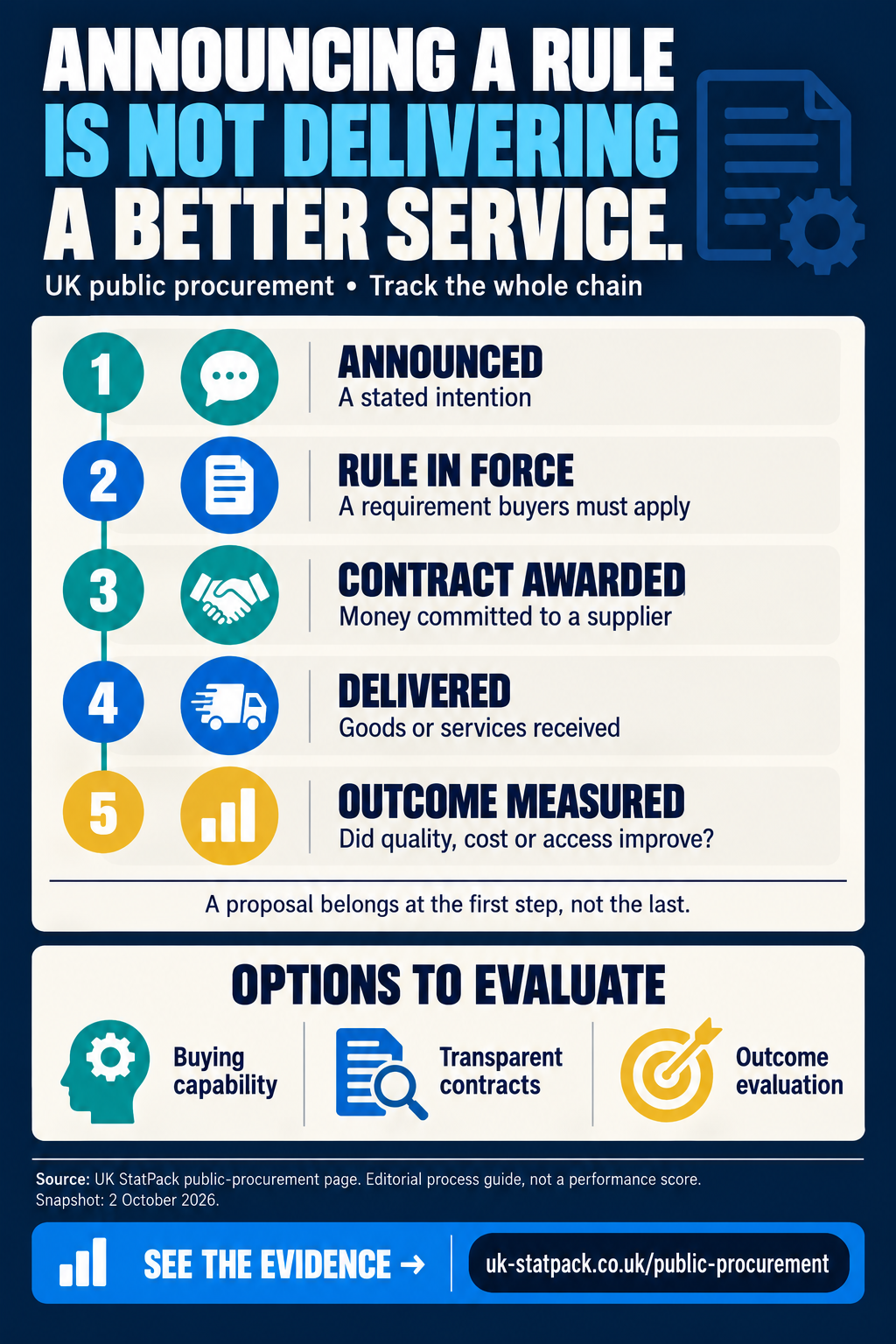
Announcing a rule is not delivering a better service.

Track the announcement, the rule in force, the contract award, delivery and the measured outcome separately.

How to read it

  1. Step 1Announcement
  2. Step 2Rule in force
  3. Step 3Contract award
  4. Step 4Delivery
  5. Step 5Measured outcome

Editorial explainer: no statistic is shown.

Editorial explainer. No statistic is shown.
Download image (PNG, 1024 by 1536 pixels)

Announcing a rule is not delivering a better service.

Announcing a rule is not delivering a better service — editorial explainer from UK Facts.
Text and data version

Announcing a rule is not delivering a better service. Track the announcement, the rule in force, the contract award, delivery and the measured outcome separately.

Editorial explainer: no statistic is shown.

Image description: Announcing a rule is not delivering a better service — editorial explainer from UK Facts.

Available images and their source records are listed on Shareable visuals.

Sources and methods (9)

Method notes

  • An announcement is not a rule, a rule is not a contract, and a contract is not an outcome. Each row moves only when a primary document shows the next stage.
  • Procurement totals are cash, outturn, from PESA; the £90bn “contracts market” in a government release is a different, unsourced measure and is not compared with them.
  • An overrun, a donation or a supplier connection is not evidence of wrongdoing. Official findings, allegations, disputes, settlements and cash recoveries are reported as different statuses.