Manifesto tracker · Labour government · selected 2024 manifesto pledges · assessed Oct 2026
Of eleven selected 2024 Labour pledges, three are on track, six are mixed and one is off track.
Eleven Labour manifesto pledges, chosen by us under the rule below and graded on each pledge’s own measure. These are our grades, not official verdicts. One is not counted in the headline because it is too early or cannot yet be assessed.
Informational purpose: Apply consistent, dated tests to selected commitments and make the evidence for each judgement inspectable.
Evidence last reviewed 11 October 2026
Overview
The short version
Three key measures
Which selected pledges does our tracker grade off track?
1 of 11
Housing — build 1.5 million homes over the parliament: 208,600 net additional homes in 2024-25, against about 300,000 a year as a simple equivalent. Also off track: none. Each is graded on the pledge’s own measure; the site’s assessment, not an official verdict.
Read the off-track assessment →UK (housing pledge: England) · Assessed Oct 2026
Source: Which selected pledges does our tracker grade off track?
Site calculation from published data · UK Facts manifesto registry; each pledge cites its own official measure
How many cannot be graded yet?
1
0 too early (deadline years away) and 1 without a sufficiently defined or evidenced test. “Highest sustained” G7 growth has no stated duration; a one-year forecast cannot supply it.
How pledges are assessed →UK · Assessed Oct 2026
Source: How many cannot be graded yet?
Site calculation from published data · UK Facts manifesto registry; each pledge cites its own official measure
How many are on track?
3
Reform planning system — reintroduce mandatory housing targets; Recruit 13,000 additional neighbourhood police officers and PCSOs; GB Energy — publicly owned clean energy company. Mostly completed actions (a law or rule changed) rather than measured results.
Funding and implementation status →UK · Assessed Oct 2026
Source: How many are on track?
Site calculation from published data · UK Facts manifesto registry; each pledge cites its own official measure
The evidence
The evidence, question by question
Government delivery scorecard
How is the government doing against its own pledges?
3 on track, 6 mixed, 1 off track, 1 cannot be assessed
Number of Labour 2024 manifesto pledges tracked here, by assessment. Each pledge has exactly one status; the bars sum to 11.
The count is only as good as the matching: a pledge is graded on the measure it names, so a waiting-list total cannot stand in for an appointments pledge. 1 of 11 cannot honestly be graded yet, and the on-track group is dominated by actions completed rather than outcomes achieved. Read the table for the evidence behind each verdict.
UK (some pledges apply to England only) · Judgements dated Oct 2026 · Site calculation (editorial assessment)
Show the workings — 3 on track, 6 mixed, 1 off track, 1 cannot be assessed
- Geography:
- UK (some pledges apply to England only) — The 11 Labour manifesto pledges selected for tracking; opposition proposals excluded
- Measure:
- Number of pledges
- Period:
- Judgements dated Oct 2026
- Status:
- Site calculation (editorial assessment)
- Calculation:
- Count of pledges by status. The selection is not every manifesto line; it is the headline pledges with a checkable target.
- Compare with:
- None — statuses are judged against each pledge’s own target, not against other governments
- Not included / breaks:
- Opposition proposals are not graded. “Superseded” is not used yet; no tracked pledge has been formally replaced.
Source: UK Facts manifesto registry; each pledge cites its own official measure (released Oct 2026).
View the data as a table
| Status | Pledges |
|---|---|
| On track | 3 |
| Mixed | 6 |
| Off track | 1 |
| Too early | 0 |
| Cannot be assessed | 1 |
How the 11 pledges were selected
A pledge is tracked here when:
- It is a commitment in the Labour 2024 general election manifesto, with the original document linked.
- It is a headline pledge: it is stated as an outcome or action for the parliament, not a general aim.
- It names a measure and a target that can be checked against published data, and a baseline and deadline where the pledge defines them.
- It falls in one of the topic areas tracked here, and the matching evidence is on a page of this site.
The pledges cover nhs, housing, economy, employment, immigration, crime, inequality. The eleven were chosen before this rule was written down, and the rule describes what they have in common. We have not checked every other manifesto commitment against it, so the set is not complete and not a representative sample. A pledge that cannot be checked against published data is not a failed pledge. Grades are changed only when a source changes, and changes are recorded under corrections.
- On track · 3
- The measure the pledge names is moving to the target on time, or the promised action has been completed.
- Mixed · 6
- Part of the pledge has been met and part has not, or the evidence points both ways.
- Off track · 1
- On the pledge’s own measure, the latest result is not on course to meet the target.
- Too early · 0
- The deadline is far enough away that a verdict now would be premature.
- Cannot be assessed · 1
- A matching measure or sufficiently defined assessment test is unavailable in this review; missing evidence is not failure.
Every government pledge: baseline, target, latest result
The 11 selected Labour 2024 manifesto commitments tracked here. Summaries link to the original documents under “Why this verdict”. “Baseline: not defined” means the pledge set no starting point, which is itself part of why some cannot be graded.
Showing 11 of 11 pledges
| Pledge | Baseline | Target and deadline | Latest measure | Assessment |
|---|---|---|---|---|
| 40,000 extra appointments per week to cut waiting timesNHS | July 2023–June 2024: 69,945,972 activities over 252 working days; adjusted to 253 days for comparison | Two million extra operations, scans and appointments each year (described as 40,000 a week); EnglandDeadline: Every year; first step in the 2024 manifesto | 5.21 million additional activities in July 2024–June 2025; 102,997 extra per standardised five-working-day week | Mixedjudged Oct 2026Why this verdictThe first full year exceeded the two-million activity pledge: NHS England reports 5,211,650 additional activities after adjusting the baseline for working days. The average weekly increase was 102,997, above 40,000; this is not a claim about every individual week. The dedicated official series ended at June 2025, so this result does not establish continued delivery in 2025–26 or 2026–27. Mixed records first-year delivery and the unverified continuation of an annual promise. Activity is not unique patients, waiting-list reduction or proof that the policy caused the increase. The separate 18-week pledge is assessed below. |
| Build 1.5 million homes over the parliamentHousing | 221,409 net additional homes in England in 2023-24, the last full year before the election | 1.5m homes over the parliament (about 300,000 a year as a simple five-year equivalent, not a formal annual target)Deadline: End of the parliament (1.5 million in total) | 208,600 net additional homes in 2024-25 | Off trackjudged Oct 2026Why this verdictThe latest complete financial-year net-additions series is below the simple 300,000-per-year equivalent of 1.5 million over five years. This is our assessment of the pace, not a formal annual target or a forecast of the final parliament total. Net additions include conversions and changes of use less demolitions; they are not all new builds. The 2024–25 financial year partly predates the election, so it is not a clean post-election cumulative total. |
| Reform planning system — reintroduce mandatory housing targetsHousing | Housing targets made advisory in the December 2023 planning framework | Reinstated mandatory local targets and updated NPPFDeadline: None stated | Mandatory targets reinstated in December 2024; replacement NPPF published 29 September 2026 | On trackjudged Oct 2026Why this verdictThe promised framework change was made in December 2024. The September 2026 replacement retains a standard-method assessment of minimum local housing need (HO1), subject to its stated exceptions and strategic planning rules. On track refers to the policy change; permissions, build-out and completed homes are separate outcomes. |
| No rises in income tax, NI rates, or VATEconomy | Rates at the July 2024 election | No increase in National Insurance, basic/higher/additional Income Tax rates, or VAT, as the manifesto described taxes on working peopleDeadline: The parliament | Employer NI rose from 13.8% to 15% from April 2025; employee main rate remains 8% | Mixedjudged Oct 2026Why this verdictThe manifesto named National Insurance without explicitly limiting it to employee contributions. The employer rate increased by 1.2 percentage points from April 2025, and the secondary threshold fell. Employee NI and the UK-government basic, higher and additional Income Tax rates were not raised. The standard VAT rate remains 20%, but its scope expanded to private school fees; domestic energy has a separate temporary zero rate. Mixed records these different components rather than redefining the promise as employee NI alone. Frozen allowances can raise tax paid without a rate rise; devolved Income Tax powers also matter. |
| Deliver economic growth — highest sustained growth in the G7Economy | No fixed comparison window stated | Highest sustained G7 growthDeadline: None stated for “sustained” | No duration or operational test for “highest sustained” growth specified in the manifesto | Cannot be assessedjudged Oct 2026Why this verdictThe pledge names the G7 but does not define the sustained period. An IMF forecast for one year is not an observed outcome and cannot establish delivery or failure of this promise. The Economy page separates observed GDP, GDP per head and forecasts. Until the duration, measure and comparison window are fixed, this tracker does not assign a delivery verdict from a single forecast. |
| Introduce employment-rights legislation within 100 days; deliver the New Deal for Working PeopleEmployment | No Employment Rights Act | Introduce legislation within 100 days, including action on exploitative zero-hours contracts and day-one rightsDeadline: Introduction within 100 days; commencement dates vary by right | Bill introduced 10 October 2024; Act passed December 2025; rights commence in stages | Mixedjudged Oct 2026Why this verdictIntroduction met the 100-day promise; the manifesto did not promise passage within one year. Some rights are in force, including April 2026 sick-pay and leave changes. The published timetable adds electronic balloting in August and longer tribunal claim limits in October, with an exception for Scottish contract claims. Further trade-union and harassment provisions are due 30 October 2026. Unfair-dismissal protection is scheduled after six months of service from January 2027, rather than the promised day-one protection. Guaranteed-hours implementation remains separate. A passed Act is not proof that every right is already available. |
| "Smash the gangs" — dismantle people-smuggling networks, increase returnsImmigration | Year ending June 2024 for arrivals; matched preceding year for the latest returns comparison | Create a Border Security Command and returns unit; disrupt smuggling and increase returnsDeadline: None stated | 33,374 small boat arrivals in the year ending Jun 2026 (down 23% on a year earlier); 41,472 in calendar 2025 | Mixedjudged Oct 2026Why this verdictThe original pledge covers enforcement institutions, smuggling networks and returns; it does not set a numerical small-boats threshold. The Home Office reports over 40,000 enforced and voluntary returns in the year to June 2026, up 8% on the preceding year. Small-boat arrivals fell from the previous rolling year but remained broadly around the inherited level. Mixed reflects these different indicators; neither arrivals nor returns alone measures the dismantling of criminal networks. No causal effect of the new command is inferred. |
| Recruit 13,000 additional neighbourhood police officers and PCSOsCrime | 17,175 FTE neighbourhood police officers and PCSOs at 31 March 2025 (official programme baseline) | 13,000 additional neighbourhood policing personnel by the end of parliamentDeadline: End of the parliament | 20,989 FTE at March 2026: +3,814 from the fixed March 2025 baseline, including 472 in training | On trackjudged Oct 2026Why this verdictThe official year-one increase of 3,814 FTE exceeded the revised 3,011 FTE delivery plan. On track is an interim assessment against that milestone, not completion of the 13,000 pledge. Police-officer growth exceeded plan while PCSO growth reached 80.6% of its component target. The figures include 472 FTE in training; they are not all deployable officers or new recruits to policing. Special constables are not included in this statistical series. The original election promise and the later March 2025 programme baseline are distinguished; unrevised older function data cannot be spliced into this series. |
| GB Energy — publicly owned clean energy companyEconomy | No Great British Energy company before October 2024 | Establish a publicly owned clean-energy company; wider clean-power ambition remains an outcome to deliverDeadline: Establishment during the parliament; clean power is a separate 2030 ambition | Company incorporated 10 October 2024; Great British Energy Act received Royal Assent 15 May 2025 | On trackjudged Oct 2026Why this verdictThe company exists and has a statutory mandate, so the establishment action is delivered. Its official governance record distinguishes incorporation in 2024 from the 2025 Act. This status does not certify investment returns, lower household bills or delivery of clean power by 2030. Those outcomes belong to the Energy evidence and cannot be inferred from incorporation. |
| VAT on private school fees — use revenue for state educationInequality | Private school fees exempt from VAT | 20% VAT applied; revenue directed to state school improvementDeadline: None stated (applied January 2025) | VAT on private school fees applied from Jan 2025 | Mixedjudged Oct 2026Why this verdictVAT at 20% on taxable private-school education and boarding took effect on 1 January 2025, subject to the published scope and exceptions. That tax change is delivered. The Budget linked the measure to education funding, but a revenue forecast is not a measured receipt and does not trace each pound to a school or establish improved educational outcomes. Mixed distinguishes the enacted tax from the wider spending and outcome claim. |
| Restore the NHS 18-week referral-to-treatment standardNHS | June 2024 RTT performance before the election; the standard itself predates the pledge | 92% of incomplete pathways within 18 weeksDeadline: End of parliament in the manifesto; March 2029 in NHS planning guidance | 65.2% within 18 weeks at August 2026, against the 92% standard | Mixedjudged Oct 2026Why this verdictThe original 2024 manifesto promises restoration of NHS performance standards, including 18 weeks. The previous record substituted a later 10-Year Plan for that promise. Current performance remains below the 92% operational standard; the restoration deadline is still ahead. Mixed records incomplete delivery without declaring the future deadline missed. The activity pledge above is a different measure, and publication of a reform plan is not achievement of a waiting-time standard. |
The measurable pledges, charted
Selected comparable measures, with their own periods and coverage. Pledges that change a law or a rule are on track once the change is made; whether it then works is a separate question, answered on the domain pages.
Was the first-year extra-activity pledge met?
5.21 million additional activities in the first year, against two million promised
Elective operations, eligible outpatient appointments and diagnostic tests; working-day adjusted. England-commissioned NHS and independent-provider activity.
The first-year aggregate exceeded the pledge. The dedicated series was discontinued after June 2025; this does not establish continued annual delivery, an increase every week, or causation by the new policy. Later activity products have different coverage and are not silently appended.
England-commissioned care · July 2024–June 2025 against July 2023–June 2024 · Official statistics; calculation reproduced from the workbook
Show the workings — 5.21 million additional activities in the first year, against two million promised
- Geography:
- England-commissioned care
- Measure:
- Additional activities, not unique patients
- Period:
- July 2024–June 2025 against July 2023–June 2024
- Status:
- Official statistics; calculation reproduced from the workbook
- Calculation:
- Compare 75,435,185 activities with 69,945,972 baseline activities scaled from 252 to 253 working days. Difference: 5,211,649.62. Weekly standardisation uses five working days; the average additional volume is 102,997.
- Compare with:
- Two million extra activities each year; described in the manifesto as 40,000 per week
- Not included / breaks:
- Excludes emergency, maternity and mental-health care, follow-ups without a procedure and specified duplicate diagnostic categories. Distinct activities for one person can each count. Not a waiting-list or health-outcome measure.
Source: NHS England, additional elective appointments, June 2025 revised workbook, Data; Notes; Method (released 16 September 2025 revision).
View the data as a table
| Measure | Activities |
|---|---|
| Annual pledge | 2,000,000 |
| Baseline, 252 working days | 69,945,972 |
| Post-election year, 253 working days | 75,435,185 |
| Additional, working-day adjusted | 5,211,650 |
| Additional per standardised five-day week | 102,997 |
Did neighbourhood policing meet its first-year milestone?
3,814 extra FTE, above the 3,011 first-year plan
Police officers and PCSOs, including trainees destined for neighbourhood roles; England and Wales, March 2026 against the fixed March 2025 BaselineThe starting point used for comparison. In policy assessments, the funded baseline means what is already provided or committed before the proposed change.UK Facts assessment method: definition and context →.
The total year-one milestone was exceeded. Police-officer growth exceeded its component plan; PCSO growth reached 80.6% of plan. This supports an interim on-track assessment, not a declaration that 13,000 has been delivered or that crime fell because of it.
England and Wales; excludes British Transport Police · 31 March 2025–31 March 2026 · Official statistics
Show the workings — 3,814 extra FTE, above the 3,011 first-year plan
- Geography:
- England and Wales; excludes British Transport Police
- Measure:
- Full-time equivalent personnel
- Period:
- 31 March 2025–31 March 2026
- Status:
- Official statistics
- Calculation:
- Published rounded totals: 20,989 minus 17,175 = 3,814 FTE. The fixed programme baseline differs from the routinely revised functions series. Rounded components may not sum exactly.
- Compare with:
- Revised first-year plan of 3,011 FTE; the wider parliament ambition is 13,000 additional personnel
- Not included / breaks:
- Includes 472 FTE in training, so these are not all deployable staff. Special constables and long-term absentees are excluded. Transfers into roles are not necessarily recruits to policing. Pre-March-2024 function data were not revalidated and are not comparable.
Source: Home Office, Police workforce March 2026, Chapter 3, tables 3.1–3.4 (released 22 July 2026).
View the data as a table
| Measure | FTE |
|---|---|
| Fixed March 2025 baseline | 17,175 |
| March 2026 total | 20,989 |
| Of which in training | 472 |
| Recorded increase | 3,814 |
| Revised year-one plan | 3,011 |
Is England building at the rate the 1.5 million pledge needs?
208,600 homes in 2024–25: 70% of the 300,000 a year the pledge implies
Net additional dwellings, England, financial years. Dashed line: 300,000 a year, the annual rate implied by 1.5 million over a five-year parliament.
Net additions have fallen for three years in a row to 208,600, so the parliament total needs a much faster rate in the remaining years. The planning changes the government made take years to show up as finished homes, which is why the planning pledge can be on track while the building pledge is off track.
England · 2006–07 to 2024–25 · Official statistics
Show the workings — 208,600 homes in 2024–25: 70% of the 300,000 a year the pledge implies
- Geography:
- England
- Measure:
- Net additional dwellings
- Period:
- 2006–07 to 2024–25
- Status:
- Official statistics
- Calculation:
- As published. The 300,000 reference is 1.5 million divided by five years; the pledge itself sets a parliament total.
- Compare with:
- 300,000 a year (implied annual rate)
- Not included / breaks:
- Net additions include conversions and changes of use, minus demolitions; they are not the same as new-build completions.
Source: MHCLG, Housing supply: net additional dwellings, England, Live Table 120 (released 20 November 2025).
View the data as a table
| Year | Net additional dwellings |
|---|---|
| 2006–07 | 214,936 |
| 2007–08 | 223,534 |
| 2008–09 | 182,767 |
| 2009–10 | 144,870 |
| 2010–11 | 137,394 |
| 2011–12 | 140,785 |
| 2012–13 | 130,611 |
| 2013–14 | 142,494 |
| 2014–15 | 176,582 |
| 2015–16 | 195,534 |
| 2016–17 | 223,234 |
| 2017–18 | 228,170 |
| 2018–19 | 247,766 |
| 2019–20 | 248,591 |
| 2020–21 | 217,754 |
| 2021–22 | 234,462 |
| 2022–23 | 234,292 |
| 2023–24 | 221,409 |
| 2024–25 | 208,600 |
Have small boat arrivals fallen since the pledge?
Arrivals rose in 2025, then fell in the year to June 2026 — back to the level the government inherited
Small boat arrivals detected, UK, by calendar year. Year-ending-June figures, which allow a like-for-like comparison with July 2024, are in the table.
Calendar 2025 saw 41,472 arrivals, more than in 2024. The latest 12 months to June 2026 were lower, at 33,374, but the Home Office says that is broadly where arrivals stood when the government took office. Arrivals alone do not measure gang disruption. Returns increased on the latest matched annual comparison; the composite pledge is assessed as mixed.
United Kingdom · 2018 to 2025; year ending June to Jun 2026 · Official statistics
Show the workings — Arrivals rose in 2025, then fell in the year to June 2026 — back to the level the government inherited
- Geography:
- United Kingdom
- Measure:
- People detected arriving by small boat
- Period:
- 2018 to 2025; year ending June to Jun 2026
- Status:
- Official statistics
- Calculation:
- As published. No numerical arrival threshold is specified in the original pledge; this is one contextual indicator.
- Compare with:
- The year ending June 2024, when the government took office (the Home Office describes the latest year as broadly in line with it)
- Not included / breaks:
- Counts detected arrivals, not all irregular entry. Removals are part of the pledge but are not charted here.
Source: Home Office, Immigration system statistics: illegal entry routes summary tables, IER_01 (released 27 August 2026 (year ending June 2026)).
View the data as a table
| Period | Arrivals |
|---|---|
| 2018 | 299 |
| 2019 | 1,843 |
| 2020 | 8,466 |
| 2021 | 28,526 |
| 2022 | 45,774 |
| 2023 | 29,437 |
| 2024 | 36,816 |
| 2025 | 41,472 |
| Year ending Jun 2025 | 43,309 |
| Year ending Jun 2026 | 33,374 |
What the opposition proposed
21 proposals from Conservative, Lib Dem, Reform, Green. These parties are not in government, so there is no delivery to grade and no verdict is given. Compare party positions in full.
| Party | Proposal | What it specified |
|---|---|---|
| Conservative | Further National Insurance cuts — reduce by additional 2pEconomy | Cut the employee main NI rate from 8% to 6% by April 2027Original 2024 manifesto |
| Conservative | Rwanda scheme — deter small boat crossings through deportationsImmigration | Zero tolerance; Rwanda scheme operationalOriginal 2024 manifesto |
| Conservative | Expand GP premises and Community Diagnostic CentresNHS | Build or modernise 250 GP surgeries and build 50 more Community Diagnostic CentresOriginal 2024 manifesto |
| Conservative | Renters Reform Bill — abolish Section 21 "no fault" evictionsHousing | Abolish no-fault evictionsOriginal 2024 manifesto |
| Conservative | Debt falling as a share of GDPEconomy | Public sector net debt falling and borrowing below 3% of GDP in the fifth forecast yearOriginal 2024 manifesto |
| Conservative | Introduce a legal cap on work and family visasImmigration | Annual binding cap on work and family visas, falling each yearOriginal 2024 manifesto |
| Lib Dem | Recruit 8,000 more GPsNHS | 8,000 more full-time equivalent GPs, through recruitment and retentionOriginal 2024 manifesto |
| Lib Dem | Right to see a GP within 7 days (or 24 hours if urgent)NHS | See a GP or the most appropriate practice staff member within seven days, or 24 hours if urgentOriginal 2024 manifesto |
| Lib Dem | Build 380,000 homes per year including 150,000 social homesHousing | 380,000 homes a year across the UK, including 150,000 social homesOriginal 2024 manifesto |
| Lib Dem | Closer economic relationship with EU / Single Market access (aspiration)Economy | Join EU single market for goods and servicesOriginal 2024 manifesto |
| Lib Dem | Create safe legal routes for asylum seekers / fix broken asylum systemImmigration | Three-month service standard for all but the most complex asylum claims; expand safe and legal routesOriginal 2024 manifesto |
| Reform | Freeze non-essential immigration, with exceptions for essential skillsImmigration | Freeze non-essential immigration; healthcare skills exceptedOriginal 2024 manifesto |
| Reform | No income tax on earnings below £20,000Economy | Personal allowance raised to £20,000Original 2024 manifesto |
| Reform | Zero NHS waiting lists — end NHS waste and inefficiencyNHS | Eliminate NHS waiting listsOriginal 2024 manifesto |
| Reform | Zero tolerance policing — end soft-touch approach, more prisonsCrime | Increase prison places; more robust policingOriginal 2024 manifesto |
| Reform | Raise the higher-rate Income Tax threshold to £70,000Economy | Keep the basic rate at 20%; begin the higher rate at £70,000Original 2024 manifesto |
| Green | Introduce an annual wealth tax with 1% and 2% ratesInequality | 1% on assets above £10 million; 2% above £1 billionOriginal 2024 manifesto |
| Green | Decarbonise the energy system as rapidly as possibleEconomy | Push for energy-system decarbonisation before 2030; wind to supply around 70% of electricity by 2030Original 2024 manifesto |
| Green | Introduce a £15 minimum wage for all agesInequality | £15 an hour regardless of age, with Employment Allowance support for small businessesOriginal 2024 manifesto |
| Green | 150,000 social rent homes per yearHousing | 150,000 new social-rent homes a year as soon as possibleOriginal 2024 manifesto |
| Green | Windfall taxes on oil and gas companies — invest in renewablesEconomy | Sustained windfall tax; redirect to renewables investmentOriginal 2024 manifesto |
Shareable visual summary
Visual summary
Of eleven selected 2024 Labour pledges, three are on track, six are mixed and one is off track.
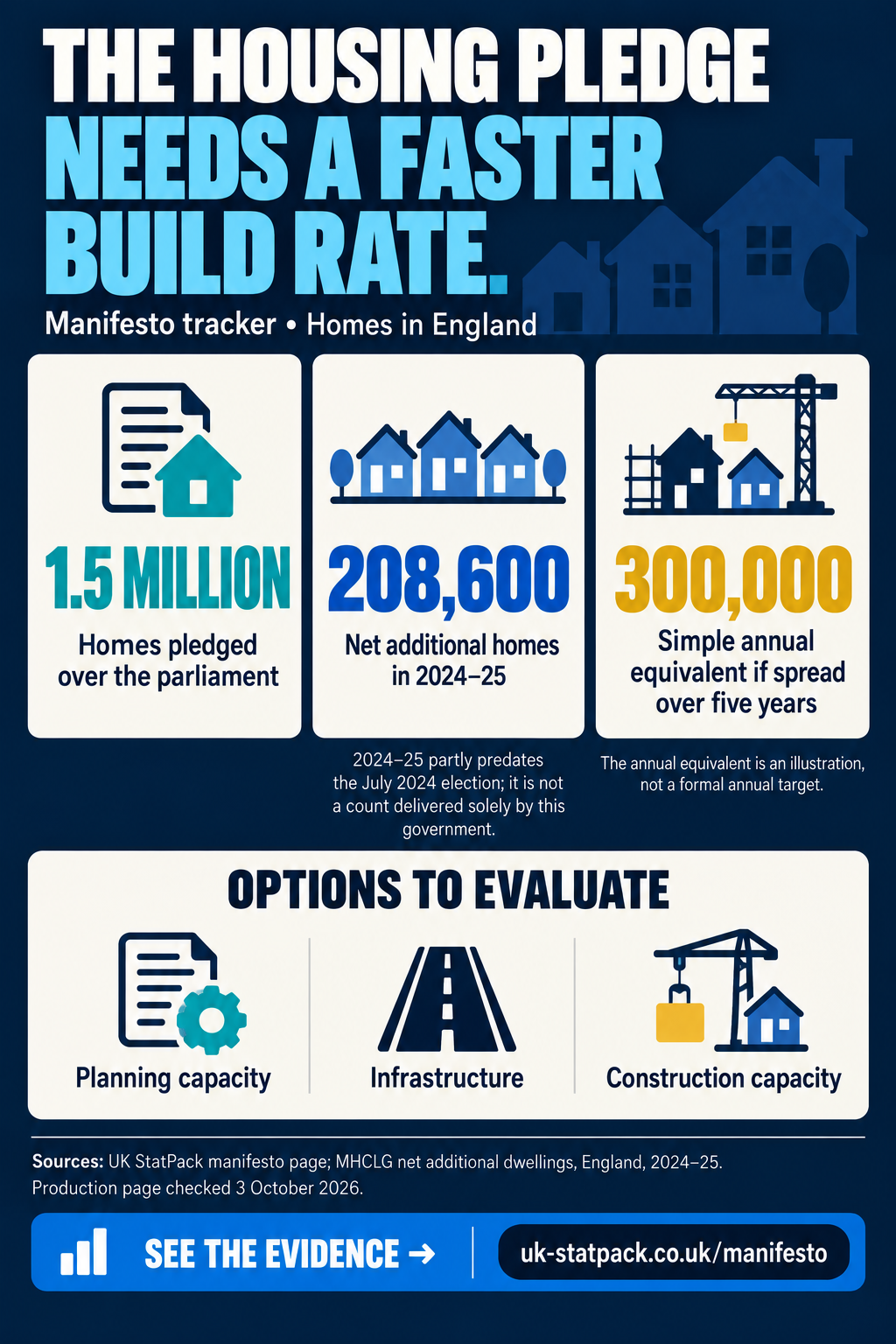
Eleven Labour manifesto pledges, chosen by us under the rule below and graded on each pledge’s own measure. These are our grades, not official verdicts. One is not counted in the headline because it is too early or cannot yet be assessed. On housing, 1.5 million homes this Parliament is about 300,000 a year on a simple five-year split; England added 208,600 homes in 2024–25.
- 3graded on track
- 6graded mixed
- 1graded off track
- 11selected 2024 Labour pledges tracked
The site’s assessment of selected pledges, not an official verdict.
Homes a year, England (same scale)
- Net additions, 2024–25208,600
- Simple five-year equivalent of the pledge300,000 a year
300,000 a year is a simple equivalent, not an official annual target.
Text and data version
Of eleven selected 2024 Labour pledges, three are on track, six are mixed and one is off track. Eleven Labour manifesto pledges, chosen by us under the rule below and graded on each pledge’s own measure. These are our grades, not official verdicts. One is not counted in the headline because it is too early or cannot yet be assessed. On housing, 1.5 million homes this Parliament is about 300,000 a year on a simple five-year split; England added 208,600 homes in 2024–25.
| Measure | Value | Period | Geography | Type | Source |
|---|---|---|---|---|---|
| Selected pledges graded on track | 3 | Assessed Oct 2026 | United Kingdom | site tracker classification (site record) | UK Facts manifesto tracker |
| Selected pledges graded mixed | 6 | Assessed Oct 2026 | United Kingdom | site tracker classification (site record) | UK Facts manifesto tracker |
| Selected pledges graded off track | 1 | Assessed Oct 2026 | United Kingdom | site tracker classification (site record) | UK Facts manifesto tracker |
| Selected 2024 Labour pledges tracked | 11 | Assessed Oct 2026 | United Kingdom | site tracker classification (site record) | UK Facts manifesto tracker |
| Homes pledged this Parliament (England) | 1.5 million | This Parliament | England | policy target | HM Government, Plan for Change milestones |
| Simple annual equivalent of the pledgeCalculation: 1,500,000 ÷ 5 years (simple equivalent; the pledge is not set as an annual target) | 300,000 a year | This Parliament | England | derived calculation | HM Government, Plan for Change milestones |
| Net additional dwellings, England | 208,600 | 2024-25 | England | observed count | Ministry of Housing, Communities and Local Government, Live Table 120 |
Image description: Manifesto infographic: the 1.5 million homes pledge implies about 300,000 a year; England added 208,600 net homes in 2024–25.
Available images and their source records are listed on Shareable visuals.
Go deeper
Government delivery scorecard1 off track, 3 on track, 1 not yet gradable, of 11.The count, with what each status means.Read the chapter → Government delivery scorecard Pledge → baseline → target → latest resultEvery government pledge, with its deadline, latest measure and the date it was judged.Filter by topic or status.Read the chapter → Pledge → baseline → target → latest result Charts for the measurable pledgesHomes, arrivals, elective activity and neighbourhood-policing milestones.Matched measures with explicit limits.Read the chapter → Charts for the measurable pledges What did the opposition propose?21 proposals from 4 parties, listed without a delivery verdict.Party positions in full.Read the chapter → What did the opposition propose? How are pledges assessed?One status per pledge, judged on the pledge’s own measure, with a date.Rules, definitions and revision history.Read the chapter → How are pledges assessed? What has the current Prime Minister promised since July 2026?A separate registry tracks the new commitments made since July 2026, stage by stage.Plans, funding, delivery and outcomes.Read the chapter → What has the current Prime Minister promised since July 2026?
Evidence → choices → outcomes
What the evidence can tell us
Every selected pledge is judged fairly against its own promise, measure and deadline, with the original document linked and wording summarised and “cannot be assessed” shown where no matching evidence exists.
How we assessed these options
What would it take to improve this?
What would move the needle?
The outcome we want: Every selected pledge is judged fairly against its own promise, measure and deadline, with the original document linked and wording summarised and “cannot be assessed” shown where no matching evidence exists.
The main constraint: Many pledges were written without a baseline, deadline or named measure, and matching delivery evidence and definitions must be checked pledge by pledge, so a fair verdict depends on the government defining and publishing those measures — an evidence and coordination constraint, not one this tracker can fix alone.
Constraint type: evidence, coordination.
The position today
Which quadrant a point sits in is our analytical judgement, not a statistical category. Each point says whether it is a measured fact, our synthesis or a risk.
What we can build on Strengths
The tracker summarises each selected Labour pledge with its original document linked and grades it only on the measure it names, with a dated judgement; “too early” and “cannot be assessed” are recorded as outcomes, not failures.
Our synthesisConfidence: Moderate
Source: Labour Party, Change: Labour Party Manifesto 2024
What government has committed to
No commitment found. No government commitment to report progress against each 2024 manifesto pledge was found. The Prime Minister told the Commons on 1 September 2026 that he would bring “much more substantial change as promised in our manifesto”, without a pledge-by-pledge report.
Searched: gov.uk search API (policy papers, speeches, press releases since 20 July 2026), the Plan for Change and planning and performance framework, 4 Oct 2026; PM statement to the Commons, 1 Sep 2026
Checked 4 October 2026. A commitment is not delivery.
Options (2)
Give every commitment an owner, budget and measurable result
A published plan per pledge would give the tracker an official measure and date to grade against.
Who: Cabinet Office and HM Treasury · Evidence: Expert or audit recommendation · Status: External proposal
Source: National Audit Office, Lessons learned: a planning and spending framework that enables long-term value for money (HC 234, Session 2024-25) (Summary paragraph 11, recommendation (a))
Publish the statistic that matches each pledge
Keeps grading on the measure each pledge names, which is what this tracker’s method protects.
Who: Departments; Office for Statistics Regulation · Evidence: Expert or audit recommendation · Status: Established
Source: Office for Statistics Regulation, Regulatory guidance on intelligent transparency (updated September 2023) (Principles 1–2)
Independent fiscal scrutiny of the 2024 manifestos was published before polling day, giving a common reference for what the pledges left out.
Measured factConfidence: High· June 2024· United Kingdom
Source: Institute for Fiscal Studies, manifesto analysis: Paul Johnson’s opening remarks (cross-party) (Opening remarks, PDF pp.1–3)
What government has committed to
No commitment found. No body is required to cost party manifestos: the OBR costs government measures at fiscal events, not manifestos, and the 2024 scrutiny was the IFS’s own independent work.
Searched: gov.uk search; OBR policy-costings remit; Charter for Budget Responsibility (Autumn 2025), 4 Oct 2026
Checked 4 October 2026. A commitment is not delivery.
Options (2)
ShortlistedApply the same independent costing test to every manifesto
One common template for every party’s plans keeps the pre-election scrutiny comparable.
Who: UK Facts; independent fiscal bodies · Evidence: Expert or audit recommendation · Status: Site-editorial action
Source: Institute for Fiscal Studies, manifesto analysis: Paul Johnson’s opening remarks (cross-party) (Opening remarks, PDF pp.2–3)
Give the OBR a remit to cost manifestos
Official costing before polling day would put every party’s numbers on one basis; it needs a change to the OBR’s remit.
Who: Parliament; HM Treasury; Office for Budget Responsibility · Evidence: Untested proposal · Status: External proposal · Works through Party comparisons: Official costings on one basis would let the parties page compare costings tables that today use different years and bases.
What is holding us back Weaknesses
The 11 tracked pledges include 1 without a defined baseline. Without a sufficiently defined or evidenced test: 1; too early to judge: 0. The remaining 10 can be graded in this review.
Our synthesisConfidence: Moderate
Source: Labour Party, Change: Labour Party Manifesto 2024
What government has committed to
Target: Plan for Change (December 2024) attached six measurable milestones to the manifesto missions for this Parliament, such as 1.5 million homes in England and 92% of patients treated within 18 weeks.
- Who and when:
- Starmer government (to July 2026), 5 December 2024.
- Since 20 July 2026:
- Not confirmed either way since the change of Prime Minister on 20 July 2026. The gov.uk missions hub has returned “gone” (HTTP 410) since 5 August 2026; no Burnham-era statement keeping or dropping the milestones was found.
- Source:
- Prime Minister’s Office and Cabinet Office, Plan for Change: Milestones for mission-led government (“Milestones for change this Parliament”, pp.12–13)
Checked 4 October 2026. A commitment is not delivery.
Options (2)
ShortlistedGive every commitment an owner, budget and measurable result
A delivery plan per pledge names the baseline and measure, so fewer pledges are “too early” or “cannot be assessed”.
Who: Cabinet Office and HM Treasury · Evidence: Expert or audit recommendation · Status: External proposal
Source: National Audit Office, Lessons learned: a planning and spending framework that enables long-term value for money (HC 234, Session 2024-25) (Summary paragraph 11, recommendation (a))
Publish the statistic that matches each pledge
Gives the pledge without a measure an official series to be graded against.
Who: Departments; Office for Statistics Regulation · Evidence: Expert or audit recommendation · Status: Established
Source: Office for Statistics Regulation, Regulatory guidance on intelligent transparency (updated September 2023) (Principles 1–2)
The IFS found neither main manifesto faced up to the fiscal choices: plausible settlements implied cuts of £10–20 billion a year to other services, which the pledges did not acknowledge.
Measured factConfidence: High· June 2024· United Kingdom
Source: Institute for Fiscal Studies, manifesto analysis: Paul Johnson’s opening remarks (cross-party) (Opening remarks, PDF p.2)
What government has committed to
Target: Pledges have to fit within the fiscal rules and the Spending Review 2025 settlements. The fiscal rules require the current budget to be in surplus in 2029-30 and public sector net financial liabilities to be falling as a share of GDP by 2029-30.
- Who and when:
- Starmer government (to July 2026), 30 October 2024.
- Since 20 July 2026:
- Kept by the Burnham government. Chancellor John Healey: the Prime Minister and he are “in lockstep in our commitment to meeting the fiscal rules at the upcoming Budget” (28 October 2026), with a buffer for uncertainty. Source: HM Treasury, Chancellor John Healey’s Growth Speech 2026 (7 September 2026) (Paragraph beginning “The Prime Minister and I are in lockstep”).
- Source:
- HM Treasury, Charter for Budget Responsibility: Autumn 2025 (laid February 2026) (Paragraphs 3.6–3.7 (fiscal mandate and supplementary target))
Checked 4 October 2026. A commitment is not delivery.
Options (2)
ShortlistedApply the same independent costing test to every manifesto
Testing every party’s plans against the same fiscal baseline before polling day exposes unacknowledged cuts.
Who: UK Facts; independent fiscal bodies · Evidence: Expert or audit recommendation · Status: Site-editorial action
Source: Institute for Fiscal Studies, manifesto analysis: Paul Johnson’s opening remarks (cross-party) (Opening remarks, PDF pp.2–3)
Show tax choices with their real trade-offs
Putting the tax and spending trade-offs the IFS said were missing on the public record as alternatives.
Who: HM Treasury; Parliament · Evidence: Modelled scenario · Status: External proposal · Works through Public finances: Packages shown with their losers on the public-finances page would make the choices manifestos left out explicit.
Source: Institute for Fiscal Studies, Options for tax increases (IFS Green Budget 2025 chapter) (Key findings)
What could improve things Opportunities
A documented delivery plan for each pledge, and one costing standard for every manifesto, would let pledges be judged on defined measures rather than on proxies.
Depends on: Departments publish plans with matching measures, and the same costing template is applied to every party.
Our synthesisConfidence: Moderate
Source: National Audit Office, Lessons learned: a planning and spending framework that enables long-term value for money (HC 234, Session 2024-25) (Summary paragraph 11, recommendation (a)); Institute for Fiscal Studies, General Election 2024: IFS manifesto analysis (event page; opening remarks by Paul Johnson published as a PDF) (Event page)
What government has committed to
Policy: A documented plan for each pledge would build on the departmental planning already promised. Under the planning and performance framework (updated November 2025) each department publishes a Strategic Plan with priority outcomes, deliverables and metrics, revised annually; the next were due “at the beginning of the financial year 2026-27, alongside Main Estimates”.
- Who and when:
- Starmer government (to July 2026), 26 November 2025.
- Since 20 July 2026:
- Not confirmed either way since the change of Prime Minister on 20 July 2026. No 2026-27 departmental Strategic Plans were found on gov.uk on 4 October 2026, and no Burnham-era statement on them; the July 2026 Rewiring the State statement promises a streamlined outcomes framework for mayors instead.
- Source:
- HM Treasury and Cabinet Office, The government’s planning and performance framework (updated 26 November 2025) (Section “Strategic outcomes and metrics”)
Checked 4 October 2026. A commitment is not delivery.
Options (2)
ShortlistedGive every commitment an owner, budget and measurable result
One documented plan per pledge, as the NAO recommends for departmental plans.
Who: Cabinet Office and HM Treasury · Evidence: Expert or audit recommendation · Status: External proposal
Source: National Audit Office, Lessons learned: a planning and spending framework that enables long-term value for money (HC 234, Session 2024-25) (Summary paragraph 11, recommendation (a))
Apply the same independent costing test to every manifesto
One costing standard for every manifesto completes the opportunity on the promise side.
Who: UK Facts; independent fiscal bodies · Evidence: Expert or audit recommendation · Status: Site-editorial action
Source: Institute for Fiscal Studies, manifesto analysis: Paul Johnson’s opening remarks (cross-party) (Opening remarks, PDF pp.2–3)
What could make it worse Threats
Changing a pledge’s definition after the fact, grading it on a proxy, or treating missing evidence as failure would bias the verdicts in either direction.
Risk, not a certaintyConfidence: Moderate
Source: National Audit Office, Lessons learned: a planning and spending framework that enables long-term value for money (HC 234, Session 2024-25) (Paragraph 2.16 (metrics not well aligned to intended outcomes))
What government has committed to
Policy: The statistics regulator’s intelligent-transparency guidance asks that figures quoted by ministers be published, sourced and explained, so a pledge’s measure cannot quietly change.
- Who and when:
- Office for Statistics Regulation (regulator or independent body), 1 September 2023.
- Source:
- Office for Statistics Regulation, Regulatory guidance on intelligent transparency (updated September 2023) (Principle 1 “Equality of access”)
Checked 4 October 2026. A commitment is not delivery.
Options (2)
Publish the statistic that matches each pledge
Fixing the measure each pledge is judged on removes the room to grade it on a proxy.
Who: Departments; Office for Statistics Regulation · Evidence: Expert or audit recommendation · Status: Established
Source: Office for Statistics Regulation, Regulatory guidance on intelligent transparency (updated September 2023) (Principles 1–2)
Give every commitment an owner, budget and measurable result
A dated plan with a stated baseline makes later redefinition visible.
Who: Cabinet Office and HM Treasury · Evidence: Expert or audit recommendation · Status: External proposal
Source: National Audit Office, Lessons learned: a planning and spending framework that enables long-term value for money (HC 234, Session 2024-25) (Summary paragraph 11, recommendation (a))
The actions worth examining
These actions concern transparency, accountability and informed choice — not a spending programme, and not a view on which party or system is right.
Action 1A37Policy status: external proposal
Give every commitment an owner, budget and measurable result
Departments publish dated delivery plans with baselines, milestones and spending for each commitment, keep the original promise and every revision, and explain slippage — so progress is judged against a plan rather than a speech.
The thread: issue, evidence, action
- Issue Weakness: The 11 tracked pledges include 1 without a defined baseline. Without a sufficiently defined or evidenced test: 1; too early to judge: 0. The remaining 10 can be graded in this review. Also: opportunity
- Evidence Tracked pledges that can be graded today; Tracked pledges without a defined or evidenced assessment test
- Action A37, this action
- Who decides:
- Cabinet Office and HM Treasury, with each responsible department; Parliament scrutinises (UK)
- Evidence:
- Expert or audit recommendation. An independent audit recommendation drawn from NAO value-for-money work; no evaluation shows that published plans improve delivery.
- Expected effect:
- Direction plausible; size not established.
- Cost and funding
Not yet costed
Funding: Not a direct public-spending programme
Why it is shortlisted here: Gives each pledge the owner, baseline and measure the tracker needs to judge it, replacing the existing delivery-plans option.
What it takes
The problem
Several tracked commitments lack a dated, costed plan. The NAO identified a publication gap in 2024; Treasury subsequently proposed annual strategic plans for 2026. Each commitment still needs a matching baseline, budget and outcome to judge delivery.
Who is affected, and where
Voters, Parliament and the people who use the services each commitment affects. Territory: UK. UK government departments; many commitments apply to England only. Devolved governments publish their own programmes and are not covered here.
Policy status
Proposed by researchers or others, not government policy. Recommended by the National Audit Office (October 2024). Its historical finding was that plans had not been republished since July 2021. Treasury’s November 2025 framework proposed annual strategic plans for 2026; the older audit does not establish current publication across all departments. UK Facts’ own registry tracks plan, authority, delivery and outcome for each tracked commitment — a site-editorial complement, not a substitute.
The evidence
- What the research found:
- The NAO recommends publishing departmental outcome delivery plans and cross-cutting mission plans at least annually, plus a summary of spending choices after each spending review. It finds government “prone to under-estimate on costs and over-promise on outcomes”.
- Evaluated on:
- UK central government planning and spending, 1998–2024; UK central government
- Our recommendation (separate from the research):
- Fill the missing owner, baseline, outcome, budget and milestone fields for every tracked commitment, publish them in the next planning cycle, and report plan completeness and service outcomes separately.
- Strongest counter-evidence:
- Plans continued inside government after 2021 without visible effect; published targets can be gamed and add workload, and publication is not delivery.
Cost and funding
Cost completeness: Not yet costed. Funding: Not a direct public-spending programme.
- Departmental analytical, finance and delivery staff time for published plans (administration; paid by central government): Not yet costed. No grant programme, but existing staff time has an opportunity cost; it is not zero. The NAO does not cost its recommendation.
- Who pays:
- Departments, from administrative budgets: analytical, finance and delivery staff time. There is no grant programme, but the staff time is a real cost.
- Financing proposed:
- A named departmental or Cabinet Office allocation, or an explicit statement of which existing work gives way.
- Gap remaining:
- Staff time not costed — not zero.
What delivery needs
- Skills:
- Analysts, finance and delivery staff.
- Operational capacity:
- Departmental performance data matched to each commitment.
- Infrastructure:
- A public register of commitments with revision history.
- Permissions:
- None.
- Law:
- None: an administrative decision.
- Public consent:
- Ministers accepting public milestones that may be missed.
First step and stages
First step: Complete the missing owner, baseline, outcome, budget and milestone fields for each tracked commitment. (owner: Cabinet Office with each department (UK Facts for its own registry))
- Complete the missing fields — Departments; UK Facts for its registry (proposed stage, not an official timetable)
- Publish in the next planning cycle — Cabinet Office and HM Treasury (proposed stage, not an official timetable)
- Report against stable milestones — Departments, scrutinised by Parliament and the NAO (proposed stage, not an official timetable)
Depends on: A matching official statistic for each commitment; Funding decisions at fiscal events
Trade-offs
- Who gains and who loses:
- Voters and Parliament gain information; the cost falls on departmental staff time.
- What else the money or effort could do:
- Analyst and finance time not spent on delivery itself.
- Strongest counterargument:
- Fixed public targets can distort priorities and invite gaming; plans existed internally without improving outcomes.
- Risks:
- Target gaming, bureaucratic workload, and treating publication as delivery.
How we would judge it
- Baseline:
- Share of tracked commitments with a dated, costed plan (this site’s delivery board).
- Leading indicator:
- Plans published with owner, baseline, budget and milestones for each commitment.
- Outcome:
- Timely service outcomes for each commitment, reported separately from plan completeness.
- Continue, adapt or stop:
- Treat plan completeness as an input only; judge success on measured outcomes, and flag any commitment whose milestones slip without a published explanation.
Earlier option on this page
This card replaces the option “Publish a delivery plan for every commitment” (external option: Recommended by the NAO; this site has not found current published plans for the commitments tracked here.). Its evidence: The NAO’s 2024 audit found outcome delivery plans had not been republished since 2021. Treasury subsequently proposed annual strategic plans for 2026; the historic audit does not establish every department’s current publication status. Publication supports accountability but is not evidence of improved outcomes. National Audit Office, Lessons learned: a planning and spending framework that enables long-term value for money (October 2024)
Sources
- National Audit Office, Lessons learned: a planning and spending framework that enables long-term value for money (HC 234, Session 2024-25), Summary paragraph 11, recommendation (a) (printed p.9) (2024-10-27; relevant passages checked)
- National Audit Office, Lessons learned: a planning and spending framework that enables long-term value for money (HC 234, Session 2024-25), Paragraph 1.17 (printed p.18): historical finding in October 2024 (2024-10-27; relevant passages checked)
- HM Treasury, Reforming the spending control and accountability framework, Table 0.1: planning and performance (November 2025; relevant passages checked)
- National Audit Office, Lessons learned: a planning and spending framework that enables long-term value for money (HC 234, Session 2024-25), Paragraph 2.52 (printed p.40) (2024-10-27; relevant passages checked)
- National Audit Office, Lessons learned: a planning and spending framework that enables long-term value for money (HC 234, Session 2024-25), Paragraph 2.16 (printed p.26): plans kept internally; some metrics poorly aligned to outcomes (2024-10-27; relevant passages checked)
Source published 27 October 2024 (NAO); evidence reviewed 2026-10-04. Reconsider if: The government publishes outcome delivery plans; The Budget confirms or changes funding for tracked commitments; A further NAO report on planning and spending.
Also on: /government, /politics/parties — one shared record, so its cost is counted once.
Action 2A38Policy status: site-editorial action
Apply the same independent costing test to every manifesto
Compare every party’s mechanisms, spending paths, funding assumptions and distributional effects on one template, keeping missing estimates visible rather than filling them in.
The thread: issue, evidence, action
- Issue Weakness: The IFS found neither main manifesto faced up to the fiscal choices: plausible settlements implied cuts of £10–20 billion a year to other services, which the pledges did not acknowledge. Also: weakness (Party comparisons), strength
- Evidence Parties that published a costings table
- Action A38, this action
- Who decides:
- UK Facts and independent analysts (scrutiny); parties (proposals); Parliament (any statutory costing role) (UK)
- Evidence:
- Expert or audit recommendation. Independent fiscal scrutiny by the IFS; not an evaluation of whether common scrutiny changes what parties propose or how people vote.
- Expected effect:
- Direction plausible; size not established.
- Cost and funding
Not yet costed
Funding: Not a direct public-spending programme
Why it is shortlisted here: Applies one costing standard to every party’s manifesto, so a pledge’s cost is not judged more harshly for one party than another. It builds on the OBR’s certification of government measures, which stays as its own option.
Builds on the option Independent costing of every tax and spending pledge compared below.
What it takes
The problem
Party costings use different years, bases and coverage, and independent scrutiny in 2024 found the main manifestos silent on the largest fiscal choices.
Who is affected, and where
Voters comparing party programmes. Territory: UK. Devolved parties often propose changes to devolved powers, so the template must show the scope of each proposal. Northern Ireland parties are not yet covered on this site.
Policy status
UK Facts proposal. The party comparison already shows each 2024 proposal on identical fields. Official costing of manifestos by the OBR is a separate option kept on the parties page; the OBR does not currently cost manifestos.
The evidence
- What the research found:
- The IFS said neither main manifesto faced up to the fiscal choices: plausible settlements for the NHS, childcare and defence would likely leave other services facing cuts of £10–20 billion a year, with £18 billion a year of real-terms cuts to investment by 2030 under existing plans. Almost all parties relied on raising £5 billion or more from tackling evasion and avoidance.
- Evaluated on:
- The 2024 general election manifestos, mainly Conservative and Labour; United Kingdom, June 2024
- Our recommendation (separate from the research):
- Publish a fixed comparison template, apply it to every party on the same evidence standard, date each assessment and keep a correction history; treat a missing costing as missing, never as zero.
- Strongest counter-evidence:
- Manifestos are statements of intent, not budgets. A common template can create false precision and favours parties with costing capacity; devolved parties’ powers differ, which limits like-for-like comparison.
Cost and funding
Cost completeness: Not yet costed. Funding: Not a direct public-spending programme.
- Common comparison template and dated assessments of every manifesto (private contribution; paid by UK Facts): Not yet costed. Editorial cost only. The parties’ own policy packages are not costs of this action.
- Who pays:
- UK Facts and independent analysts (research time). Parties’ policy packages carry their own costs, which stay uncommitted unless adopted and funded through the proper process.
- Financing proposed:
- UK Facts’ research budget.
- Gap remaining:
- Staff time not costed.
What delivery needs
- Skills:
- Fiscal analysts.
- Operational capacity:
- Review time during an election period.
- Infrastructure:
- The party-comparison data.
- Permissions:
- None.
- Law:
- None (a statutory OBR role would need legislation).
- Public consent:
- Parties publishing enough detail to assess.
First step and stages
First step: Publish a fixed comparison template, and seek clarification from parties only through an authorised editorial process. (owner: UK Facts editors)
- Publish the template — UK Facts editors (proposed stage, not an official timetable)
- Source review of every party — UK Facts with independent analysts (proposed stage, not an official timetable)
- Dated assessments with a correction history — UK Facts editors (proposed stage, not an official timetable)
Depends on: Parties publishing costings; A37: delivery evidence for the party in office
Trade-offs
- Who gains and who loses:
- Informs all voters; parties with complete costings are easier to scrutinise, which may disadvantage small parties with little costing capacity.
- What else the money or effort could do:
- Editorial time.
- Strongest counterargument:
- Detailed costing rewards parties with civil-service-style capacity and can crowd out debate about values and priorities.
- Risks:
- False precision, different devolved powers, and confusing a missing costing with a deliberately zero-cost policy.
How we would judge it
- Baseline:
- Party–issue cells covered and parties with published costings (party comparison page).
- Leading indicator:
- Share of proposals assessed on the template with a dated source.
- Outcome:
- Unresolved costing gaps visible for every party; reproducible judgements.
- Continue, adapt or stop:
- Revise the template if two reviewers reach different results on the same proposal.
Sources
- Institute for Fiscal Studies, manifesto analysis: Paul Johnson’s opening remarks (cross-party), Opening remarks, PDF pp.2–3 (2024-06-24; full text checked)
- Institute for Fiscal Studies, General Election 2024: IFS manifesto analysis (event page; opening remarks by Paul Johnson published as a PDF), Event page summarising the same analysis (2024-06-24; relevant passages checked)
Source published 24 June 2024 (IFS); evidence reviewed 2026-10-04. Reconsider if: A general election is called; A party publishes a new programme; Legislation gives the OBR a manifesto-costing role.
Also on: /politics/parties — one shared record, so its cost is counted once.
Decision brief
The leading option set out as a decision someone could take: who decides, who benefits, the best evidence, cost and funding, and the main trade-off. The full research record is one click away.
Decision briefStatutory/accountability reformReviewed 2026-10-04
Publish a catch-up path for every off-track pledge, starting with 1.5 million homes
The thread: issue, evidence, action
- Issue Weakness: The 11 tracked pledges include 1 without a defined baseline. Without a sufficiently defined or evidenced test: 1; too early to judge: 0. The remaining 10 can be graded in this review. Also: opportunity
- Evidence Tracked pledges that can be graded today; Tracked pledges without a defined or evidenced assessment test
- Action Give every commitment an owner, budget and measurable result
- Decision required
- For each pledge graded off track, the responsible department publishes the cumulative position, the pace now required, the interventions already committed, the decision that is blocking faster progress and dated scenarios. For housing: 208,600 net additional homes counted so far against 1.5 million means 322,850 a year for the remaining 4 years.
- Who and where
- Voters, Parliament and the people each off-track pledge affects. Applies in: UK.
- Accountable body
- The Cabinet Office with each responsible department (MHCLG for the housing pledge); UK Facts for this tracker’s counting rules.
- Intervention
- Publish, for each off-track pledge, the cumulative position, the pace required and the decision that blocks it.
- Best evidence, and where it applies
- The NAO recommends published delivery plans with baselines and milestones; MHCLG’s net additional dwellings series gives the housing baseline.Studied in: UK central government departments (Spending frameworks 1998–2024).
- Extra cost of this change
- Capital: none identified in the brief.Recurring: Departmental analytical time to publish catch-up paths — Not yet costed.
- Funding
- Mainly a legal or regulatory change: administration costs still need a budget.Committed to this change: none.Possible source, not an award: none identified.Unfunded: Staff time is not costed, which is not the same as free.
- Savings and wider benefits
- Not yet specified: no cashable saving or avoided cost has been costed for this change. Expected outcomes are listed one by one in the research appendix and are never added together or counted as money available.
- First 90-day step
- This tracker publishes the cumulative position and required pace for each off-track pledge, with its counting rules, and asks departments to publish theirs by the next fiscal eventThe proposed first milestone; a 90-day date is not yet specified. Owner: UK Facts editors (tracker); Cabinet Office and departments (official paths). Proposed by UK Facts, not an official deadline.
- Twelve-month milestone
- Not yet specified.Time to a first useful result: Immediately for the tracker’s calculation; the next annual housing supply release for the first test of the path.
- Outcome, and when to scale or stop
- Measure: Housing: planning permissions and starts on site; other pledges: their own leading measures.Scale if: Outturn reaches the required pace or the published path, with revisions explained.Stop if: A department redefines the measure without explanation — then the tracker keeps the original measure and records the change.
- Main trade-off
- A published catch-up path makes a likely miss visible early, which governments resist; without it, a miss is only confirmed at the end of the parliament.
- Source and review date
- Lessons learned: a planning and spending framework that enables long-term value for money (HC 234, Session 2024-25) (October 2024); Economic and fiscal outlook, March 2025 (26 March 2025). Reviewed 2026-10-04.
An editorial proposal by UK Facts for discussion, not government policy. Records: A37 · costs C-A37-ANALYSTS
Research appendix: study design, effect sizes and limits, alternatives, full costing, international comparisons and how we would know
1.The change, in plain words
Publish a catch-up path for every off-track pledge, starting with 1.5 million homes
2.The decision requested
- Decision
- Ask each department that owns an off-track pledge to publish a catch-up path by the next fiscal event, and adopt the same declared counting rules on this tracker now (housing counted over financial years 2024–25 to 2028–29; “highest sustained growth” judged on a stated rolling window of annual G7 growth).
- Accountable institution
- The Cabinet Office with each responsible department (MHCLG for the housing pledge); UK Facts for this tracker’s counting rules.
- Geography
- UK
- Powers
- No new legislation: departments can publish delivery information under existing ministerial authority; Parliament can require it through select committees. The tracker’s rules are an editorial decision.
- Delivery partners
- HM Treasury (funding position at the Budget); Homes England and local planning authorities (housing); ONS and MHCLG statisticians (matching series); Commons select committees
3.Who it is for, and what changes beyond today
- Target population
- Voters, Parliament and the people each off-track pledge affects.
- Eligibility
- Pledges this tracker grades off track (1 of 11 tracked): Build 1.5 million homes over the parliament.
- Scale
- 1 pledges now; any pledge that moves to off track joins automatically.
- Baseline
- England added 208,600 net homes in 2024–25. Counted from 2024–25, the cumulative total is 208,600, so reaching 1.5 million needs 322,850 a year for the remaining 4 years; the highest year in the series since 2006–07 was 248,591 (2019–20). At the latest year’s pace the window would end at about 1,043,000.
Source: MHCLG, Housing supply: net additional dwellings, England (Live Table 120, net additional dwellings, England); Labour Party, Change: Labour Party Manifesto 2024 (Housing pledge wording)
- Change beyond existing law or funding
- Today the tracker compares the latest year with a simple 300,000-a-year equivalent, and no department publishes a trajectory for any pledge. The change adds the cumulative position, the required pace, the committed interventions, the blocking decision and dated scenarios for each off-track pledge, with every regrading dated.
4.How it would work
Do: Publish, for each off-track pledge, the cumulative position, the pace required and the decision that blocks it Changing: so that slippage is visible years before the deadline and attributed to a named decision rather than to the pledge in general
Off-track pledges have a published catch-up path and a named blocking decision
Hypothesis to test
An accountability output. Publication is not delivery: the NAO notes plans existed inside government after 2021 without visible effect.
Earlier corrective decisions (funding, planning, delivery capacity) on pledges that are slipping
Hypothesis to test
No evaluation shows that publishing trajectories speeds delivery; to be tested by comparing pledges with and without published paths.
Outcomes are kept separate and never added into one impact figure.
5.Best evidence
- Author or institution:
- National Audit Office
- Published:
- October 2024
- Evaluation period:
- Spending frameworks 1998–2024
- Design:
- Audit synthesis of past planning and spending frameworks
- Sample or population:
- UK central government departments
- Effect and uncertainty:
- Recommends publishing departmental outcome delivery plans and mission plans at least annually; finds government “prone to under-estimate on costs and over-promise on outcomes”. Outcome delivery plans were last published in July 2021.
- Limits:
- An audit recommendation, not an evaluation: it does not show that publication improves delivery.
Where: Summary paragraph 11, recommendation (a); paragraph 1.17; paragraph 2.52. Affiliation is provenance, not proof of quality.
Economic and fiscal outlook, March 2025
- Author or institution:
- Office for Budget Responsibility
- Published:
- 26 March 2025
- Evaluation period:
- 2025–26 to 2029–30 (forecast)
- Design:
- Modelled judgement of the revised planning framework
- Sample or population:
- Housing supply in England
- Effect and uncertainty:
- About 170,000 extra net additions over 2025–26 to 2029–30 from the December 2024 planning reforms — the main committed intervention for the housing catch-up path.
- Limits:
- A forecast judgement over a different five-year window from the counting rule above; it is shown beside the required pace, never added to it.
Where: Paragraphs 1.10 and 3.37. Affiliation is provenance, not proof of quality.
6.Alternatives, counter-evidence and who loses
- Closest feasible alternative
- Keep grading against the simple annual equivalent and judge the total only at the end of the parliament.
- Strongest counter-evidence
- Published trajectories can be gamed (counting changes of use, moving the window) and add departmental workload; the 2021 plans were kept internal without visible effect.
Source: National Audit Office, Lessons learned: a planning and spending framework that enables long-term value for money (HC 234, Session 2024-25) (Paragraph 1.17 (printed p.18))
- Distributional effects
- None directly; the pledges themselves have distributional effects that stay on their own pages (housing: people who need a home in high-demand areas).
- Main downside
- A credible catch-up path may show the pledge cannot be met, which can push governments to redefine the measure rather than change delivery.
| Option | Who is reached | Evidence | Likely outcome and timing | Cost and funding | Main trade-off |
|---|---|---|---|---|---|
| The proposalCatch-up path for every off-track pledge: cumulative position, required pace, blocking decision, scenarios | Voters and Parliament; each off-track pledge | NAO recommendation; official series | Tracker version now; official paths by the next fiscal event if departments agree | Staff time, not costed; existing budgets | Makes a likely miss visible early |
| Current policyCurrent tracker: latest year against a simple annual equivalent | Readers of the tracker | Official series; simple arithmetic | No change | Existing site time | Ignores years already counted and overstates or understates the task |
| AlternativeJudge only at the end of the parliament | Voters at the next election | Final outturn only | A verdict after it is too late to correct | None | No early warning |
The options compared, including current policy
The proposal
Catch-up path for every off-track pledge: cumulative position, required pace, blocking decision, scenarios
- Who is reached
- Voters and Parliament; each off-track pledge
- Evidence
- NAO recommendation; official series
- Likely outcome and timing
- Tracker version now; official paths by the next fiscal event if departments agree
- Cost and funding
- Staff time, not costed; existing budgets
- Main trade-off
- Makes a likely miss visible early
Current policy
Current tracker: latest year against a simple annual equivalent
- Who is reached
- Readers of the tracker
- Evidence
- Official series; simple arithmetic
- Likely outcome and timing
- No change
- Cost and funding
- Existing site time
- Main trade-off
- Ignores years already counted and overstates or understates the task
Alternative
Judge only at the end of the parliament
- Who is reached
- Voters at the next election
- Evidence
- Final outturn only
- Likely outcome and timing
- A verdict after it is too late to correct
- Cost and funding
- None
- Main trade-off
- No early warning
7.What other countries or the devolved nations show
No comparable evaluation found.
Searched: Published evaluations of government pledge trackers or published delivery trajectories (Institute for Government case studies of the UK Prime Minister’s Delivery Unit and its trajectories, 2001–2010, which are qualitative; the Inter-American Development Bank’s 2018 study of delivery units, which attributes no result causally to them), looking for a measured effect of publishing trajectories on delivery.
Next step: Record, for each off-track pledge, the date a catch-up path is published and the subsequent pace, and compare with pledges that have none; revisit if an evaluation of a published tracker appears.
8.What delivery needs first
- data — A matching official series and a declared counting window for each pledge (housing: MHCLG net additional dwellings; growth: a stated rolling window of annual G7 growth). (Requirement; owner: UK Facts editors; ONS and MHCLG statisticians)
- dependency — The housing path depends on the decisions in the national pipeline-and-sites brief (planning, enabling infrastructure and social-rent grant). (Genuine veto: nothing proceeds without it; owner: MHCLG and HM Treasury)
- staff — Departmental analysts to produce scenarios with stated assumptions. (Scarce resource shared with other priorities; owner: Responsible departments)
9.What it would cost
How the cost is built up: Analyst time per pledge × off-track pledges × updates a year. No programme spending; the pledges’ own delivery costs stay on their own pages.
| Component | Unit and quantity | Unit cost or amount | Type, price year, period | Status |
|---|---|---|---|---|
| Departmental analytical time to publish catch-up pathsDepartments owning off-track pledges, plus Cabinet Office coordination | staff time per update; quantity to be set from need and capacity | Not yet costed (ledger C-A37-ANALYSTS) | recurring; price year not stated; Each fiscal event | Not yet established |
Departmental analytical time to publish catch-up paths
Departments owning off-track pledges, plus Cabinet Office coordination
Not yet costed (ledger C-A37-ANALYSTS)
recurring; price year not stated; Each fiscal event; Not yet established
10.Who pays, and what is missing
- Programme envelope (a possible route, not an award)
- None identified
- Allocation committed to this change
- None
- Remaining gap
- Staff time is not costed, which is not the same as free.
- Proposed financing
- Existing departmental administration budgets; this tracker’s editorial budget for its own calculation.
- Responsible payer
- central government, UK Facts
- Budget displaced
- Analytical time that would otherwise go to other policy work in each department.
11.First milestone and time to a useful result
This tracker publishes the cumulative position and required pace for each off-track pledge, with its counting rules, and asks departments to publish theirs by the next fiscal event (Owner: UK Facts editors (tracker); Cabinet Office and departments (official paths). Proposed by UK Facts, not an official deadline.)
Time to first useful result: Immediately for the tracker’s calculation; the next annual housing supply release for the first test of the path.
What could delay it: Departments decline to publish trajectories The parliament ends before 2028–29, shortening the counting window Statistical revisions change the cumulative total
12.How we would know
- Baseline
- Housing: 208,600 counted to 2024–25; required pace 322,850 a year.
- Comparison
- Each year’s outturn against the required pace and against the department’s own published path, if one exists.
- Leading indicator
- Housing: planning permissions and starts on site; other pledges: their own leading measures.
- Follow-up
- Each annual release of the matching series, until the deadline.
- Continue if
- Outturn reaches the required pace or the published path, with revisions explained.
- Adapt if
- The required pace rises above anything achieved in the series: the path must name the extra decision needed, or the pledge is graded as unlikely to be met.
- Stop if
- A department redefines the measure without explanation — then the tracker keeps the original measure and records the change.
- Thresholds
- Not yet set: The required pace is arithmetic from the pledge, not a threshold; no other numerical trigger is set without a published departmental plan.
What is not yet known, and how to find out
- What departments’ analytical time for catch-up paths would cost (cost)Next step: Ask the Cabinet Office for the staffing used for the 2021 outcome delivery plans as a benchmark.Scope: Off-track pledges, each fiscal event · Data or quotes needed: Staff hours from the 2021 plans · Who can estimate it: Cabinet Office
- Whether published trajectories speed up delivery (effect)Next step: Compare pace after publication with pledges that have no published path.Defensible route: evaluation of existing delivery
- Which growth window and comparator define “highest sustained growth” (data)Next step: Publish the tracker’s rule (rolling window of annual real GDP growth across the G7, stated length) and date any change to it.
Sources last checked 4 October 2026 · Owner: Evidence editor (James Harris) · Next check: the first trigger: MHCLG housing supply statistics (net additional dwellings, annual).
More decision briefs on other pages
- Cost every main party’s manifesto independently, then track the winner’s promises against those costings — the brief for “Apply the same independent costing test to every manifesto”, on Party comparisons
What it would take
The order things have to happen in
First, the prerequisite
Record a baseline and matching measure for every tracked pledge, or mark it unassessable
Owner: UK Facts (tracker); departments (official measures)
No date: the timing depends on the steps before it.
Then, the decision
Publish delivery plans against each pledge
Owner: Cabinet Office, HM Treasury and departments
No date: the timing depends on the steps before it.
Then, delivery
Apply one costing template to every manifesto at the next election
Owner: UK Facts with independent analysts
No date: the timing depends on the steps before it.
Finally, the measured outcome
Fewer pledges that cannot be assessed; verdicts that reproduce when re-checked
Owner: UK Facts
No date: the timing depends on the steps before it.
Who pays, and what is still missing
Cost, committed funding and the remaining gap for the same scope and years. A programme envelope is not an award to a project; a proposal is not committed money. None of these costs has been established yet, so no total is shown.
Cost and funding ledger
Departmental analytical, finance and delivery staff time for published plans
A37 · administration · not costed
- Amount
- Not yet costed
- Who pays
- central government
- Committed
- None identified
- Proposed, not committed
- —
- Gap
- Not established
Common comparison template and dated assessments of every manifesto
A38 · private contribution · not costed
- Amount
- Not yet costed
- Who pays
- UK Facts
- Committed
- None identified
- Proposed, not committed
- —
- Gap
- Not established
“Not yet costed” means no defensible cost has been found — not that the action is free. Lifetime benefits, benefit-cost ratios and forecast savings are never shown here as money available to spend.
What the evidence says each action changes
No effect has been established for these actions yet: direction plausible; size not established.
How we would know
The outcome measures to watch. A baseline is where we start, not a target; where there is no official target we say so.
Tracked pledges without a defined or evidenced assessment test
pledges · United Kingdom
- Baseline
- Not published
- Latest
- 1 of 11
- Oct 2026
Target: none — depends on sufficiently defined tests and matching evidence; no target set.
Source: Labour Party, Change: Labour Party Manifesto 2024 (Pledges as worded; status assessed by UK Facts against each pledge’s own measure). Next release: at each tracker review (check the release calendar).
Tracked pledges with a stated baseline
pledges · United Kingdom
- Baseline
- Not published
- Latest
- 10 of 11
- Oct 2026
Target: none — shown so readers can see how many verdicts rest on a defined starting point.
Source: Labour Party, Change: Labour Party Manifesto 2024 (Baselines recorded by UK Facts for each pledge). Next release: at each tracker review (check the release calendar).
Tracked pledges that can be graded today
pledges · United Kingdom
- Baseline
- Not published
- Latest
- 10 of 11
- Oct 2026
Target: none — pledges move from “too early” as deadlines approach; not a target.
Source: Labour Party, Change: Labour Party Manifesto 2024 (Statuses assessed by UK Facts). Next release: at each tracker review (check the release calendar).
Where the ideas come from
Research, counter-evidence and methods (5 sources; 2 claims held back)
- Change: Labour Party Manifesto 2024 — Labour Party, June 2024.Party manifesto (primary text of each pledge); United Kingdom. Relevant passages checked, 2026-10-04.
- manifesto analysis: Paul Johnson’s opening remarks (cross-party) — Institute for Fiscal Studies (Paul Johnson), 2024-06-24.Independent fiscal scrutiny (opening remarks, manifesto analysis); United Kingdom. Full text checked, 2026-10-04. Limits: Projections and judgements at June 2024 about the 2024 manifestos; not current party policy.
- Lessons learned: a planning and spending framework that enables long-term value for money (HC 234, Session 2024-25) — National Audit Office, 2024-10-27.Audit synthesis of NAO value-for-money work (HC 234, 2024–25); UK central government. Relevant passages checked, 2026-10-04. Limits: Written before the 2025 Spending Review; a published plan is an input to accountability, not a service improvement.
- General Election 2024: IFS manifesto analysis (event page; opening remarks by Paul Johnson published as a PDF) — Institute for Fiscal Studies, 2024-06-24.Cross-party fiscal scrutiny of the 2024 manifestos; United Kingdom. Relevant passages checked (read from an Internet Archive copy), 2026-10-04. Limits: An event summary; figures used on this site are taken from the opening-remarks PDF (registered separately), which was read in full. Projections at June 2024.
- Reforming the spending control and accountability framework — HM Treasury, November 2025.Government policy paper; United Kingdom. Relevant passages checked, 2026-10-04.
Counter-evidence and criticism
- Give every commitment an owner, budget and measurable result: Plans continued inside government after 2021 without visible effect; published targets can be gamed and add workload, and publication is not delivery. (National Audit Office)
- Apply the same independent costing test to every manifesto: Manifestos are statements of intent, not budgets. A common template can create false precision and favours parties with costing capacity; devolved parties’ powers differ, which limits like-for-like comparison.
Claims held back
- An official verdict on any pledge — The statuses are UK Facts’ dated assessments; no official body grades manifesto delivery. Needed: Not applicable: statuses stay labelled as the site’s judgement.
- Costings for opposition proposals on a common basis — Parties used different years and bases in 2024; the IFS did not re-cost them on one basis. Needed: The common template in A38, applied at the next election.
“Full text checked” means we read the report itself; “relevant passages” means the sections behind each figure; “summary or abstract only” means we could not read the full study, so no number from it is published here without another source.
Other options compared — not on the shortlist (2)
Other options compared
Options from earlier work on this page that are not on the shortlist. They remain valid choices; their evidence is shown as before.
- preventionStatus: operating
Independent costing of every tax and spending pledge
- Aims to:
- The cost of each measure is tested before it is relied on, so pledges are not announced with figures that later change.
- How:
- The OBR scrutinises the government’s draft costings of tax and spending measures before each fiscal event and says whether it endorses them as reasonable central estimates.
- Who decides:
- HM Treasury (costings) and the Office for Budget Responsibility (scrutiny).
- Main constraint:
- Measures announced between fiscal events are costed only when they reach one.
- Evidence:
- Moderate evidence — evaluated, with limits on scope or transfer
See the trade-offs and evidence
- What the evidence shows
- OBR certification is an established, published process at every fiscal event. It tests the cost estimate, not whether a measure is delivered or works.
- Policy status
- Applies to measures announced at fiscal events; the electricity VAT cut and pubs relief are due to be scored at the Budget on 28 October 2026.
- Resources
- OBR and Treasury analysts.
- Consent and decisions needed
- Already in law (Budget Responsibility and National Audit Act 2011).
- Time
- At each fiscal event.
- Cost and yield
- Within existing OBR and Treasury budgets.
- Trade-offs and who pays
- Waiting for a fiscal event can delay announcements; costings carry uncertainty the OBR itself rates.
- How we would know it worked
- Leading indicator: Share of tracked funded commitments with an OBR-certified costing. Outcome: Smaller revisions between announced and final costs. It would not be working if: Certified costings are repeatedly revised by large amounts after delivery.
- preventionStatus: operating
Publish the statistic that matches each pledge
- Aims to:
- Every pledge can be judged on the measure it actually promised, not a proxy.
- How:
- Departments publish, and cite, the specific official measure each pledge depends on — for example additional elective activity for an appointments pledge, or neighbourhood officer numbers for a policing pledge — in line with the statistics regulator’s transparency guidance.
- Who decides:
- Departments and their heads of profession for statistics; Office for Statistics Regulation (oversight).
- Main constraint:
- Some outcomes take years to measure, and new collections need time to become reliable.
- Evidence:
- Not evaluated — a mechanism to test, not an evidenced fix
See the trade-offs and evidence
- What the evidence shows
- The Office for Statistics Regulation asks that figures used by ministers be published, sourced and explained. Whether matching statistics improve delivery has not been evaluated.
- Policy status
- The guidance exists; several tracked pledges still have no matching published series.
- Resources
- Statistical staff; sometimes new data collection.
- Consent and decisions needed
- Administrative; no legislation needed.
- Time
- Months for existing data; a year or more for new collections.
- Cost and yield
- No official costing.
- Trade-offs and who pays
- New measures can break comparisons with older series.
- How we would know it worked
- Leading indicator: Share of tracked pledges with a matching published measure. Outcome: Fewer pledges that “cannot be assessed”. It would not be working if: Matching measures exist but ministers continue to cite proxies.
| Option | Resources | Time | Evidence | Outcome to watch |
|---|---|---|---|---|
| Independent costing of every tax and spending pledge | OBR and Treasury analysts. | At each fiscal event. | moderate | Smaller revisions between announced and final costs. |
| Publish the statistic that matches each pledge | Statistical staff; sometimes new data collection. | Months for existing data; a year or more for new collections. | not evaluated | Fewer pledges that “cannot be assessed”. |
Plan reviewed 2026-10-11. How we judge evidence.
How this connects
- What has the government promised since July 2026?
New commitments made by the current Prime Minister are tracked stage by stage on their own board.
- Where does the housing pipeline stall?
The building pledge depends on permissions, finance and construction capacity, each measured separately.
- What do the other parties propose?
Opposition policy positions in full, with no delivery verdict.
Assessment rules and revision history
- Selection: It is a commitment in the Labour 2024 general election manifesto, with the original document linked. It is a headline pledge: it is stated as an outcome or action for the parliament, not a general aim. It names a measure and a target that can be checked against published data, and a baseline and deadline where the pledge defines them. It falls in one of the topic areas tracked here, and the matching evidence is on a page of this site. The eleven were chosen before this rule was written down, and the rule describes what they have in common. We have not checked every other manifesto commitment against it, so the set is not complete and not a representative sample. A pledge that cannot be checked against published data is not a failed pledge. Grades are changed only when a source changes, and changes are recorded under corrections.
- Population: 11 selected 2024 government commitments, not the complete manifesto or a representative sample. Equal row counts are not weights for cost or importance. Wording is summarised; original documents are linked in each row.
- Composite pledges distinguish actions, interim milestones and outcomes. On track is not necessarily completed; mixed can record an achieved component and a remaining evidence gap.
- Each pledge is judged on the measure it names. Extra appointments, waiting-list size and 18-week performance are different tests; one cannot stand in for another.
- Every pledge has exactly one status, so counts always sum to the population. “Too early” and “cannot be assessed” are real outcomes, not failures.
- Each judgement carries the month it was made; a later release can change it, and changes are recorded under corrections.
- Commitments made by the current Prime Minister since July 2026 are tracked on /government, using a separate stage-by-stage board.
Sources and methods (7)
- Labour Party, Change: Labour Party Manifesto 2024 — pledge wording and targets
- MHCLG, Housing supply: net additional dwellings, England, Live Table 120 (released 20 November 2025) — housing pledge (net additional dwellings)
- Home Office, Immigration system statistics: illegal entry routes summary tables, IER_01 (released 27 August 2026 (year ending June 2026)) — small boats pledge
- Home Office, Police workforce March 2026, Chapter 3 — neighbourhood policing milestones, FTE and training scope
- NHS England, additional elective activity June 2025 revised — first-year additional activity against its working-day-adjusted baseline
- DBT, Plan to Make Work Pay and Employment Rights Act: timeline update (25 September 2026) — commencement of employment rights
- NHS England, Referral to treatment waiting times (shared with /nhs) — context for the appointments pledge
Method notes
- Selection: It is a commitment in the Labour 2024 general election manifesto, with the original document linked. It is a headline pledge: it is stated as an outcome or action for the parliament, not a general aim. It names a measure and a target that can be checked against published data, and a baseline and deadline where the pledge defines them. It falls in one of the topic areas tracked here, and the matching evidence is on a page of this site. The eleven were chosen before this rule was written down, and the rule describes what they have in common. We have not checked every other manifesto commitment against it, so the set is not complete and not a representative sample. A pledge that cannot be checked against published data is not a failed pledge. Grades are changed only when a source changes, and changes are recorded under corrections.
- Population: 11 selected 2024 government commitments, not the complete manifesto or a representative sample. Equal row counts are not weights for cost or importance. Wording is summarised; original documents are linked in each row.
Corrections and changes
- 2026-10-11: Added the published NHS activity and neighbourhood-policing measures; corrected the employment introduction deadline, tax scope and opposition targets. Replaced the later NHS 10-Year Plan proxy with the original 18-week commitment. Growth is unassessable without a sustained-period definition; arrivals alone no longer grade the smuggling-and-returns pledge. Removed unsupported health projections from the registry.